Disclosure: this post contains affiliate links. If you sign up through one, we may earn a commission at no extra cost to you. We only recommend tools a CPA has reviewed from the vendor's own pages.
How does a foreign company hire an employee in Canada?
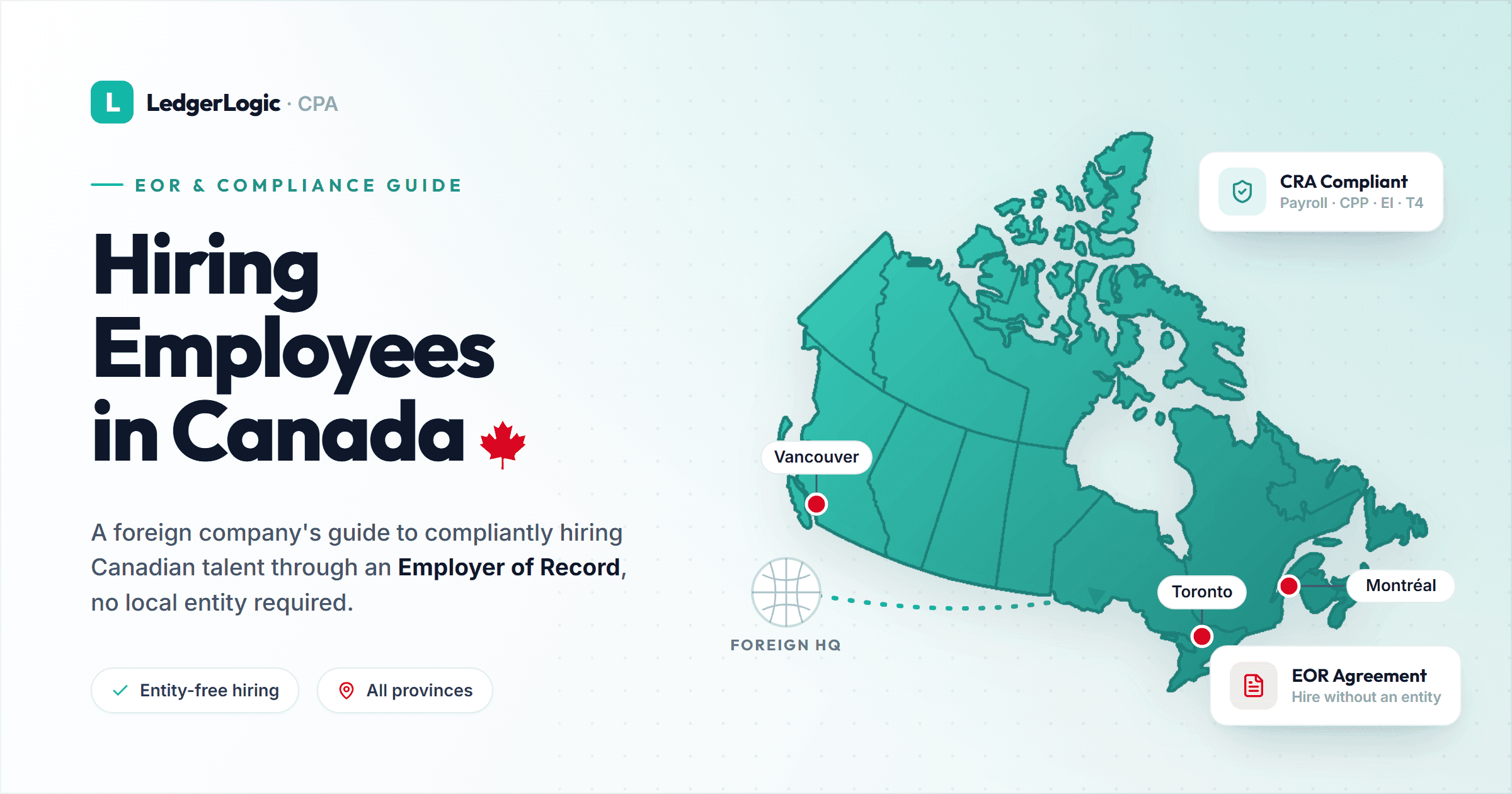
For a US or international company, the fastest compliant way to put someone on payroll in Canada is an Employer of Record (EOR). Deel's wholly owned Canadian entity becomes the legal employer and handles CPP, EI, income-tax withholding, T4s, ROEs, and provincial employment standards, so you can hire in a day or two without incorporating in Canada. Budget roughly 8 to 12 percent on top of salary for employer costs, and treat Quebec as its own regime. See Deel's Canada EOR.
At a Glance
On paper, hiring in Canada looks like hiring in the United States: same language in most of the country, a familiar business culture, a short flight away. Then you try to put someone on payroll and the differences appear fast. Payroll is run province by province, there is no at-will employment, and Quebec operates a parallel system of its own. Here is how hiring a Canadian employee actually works in 2026, written by a Canadian CPA, and where an Employer of Record like Deel removes most of the friction.
The fast answer: your own entity or an EOR
There are two compliant ways for a foreign company to employ someone in Canada. You can register your own Canadian entity, open a CRA payroll account, and take on the filings yourself, which takes weeks to months and creates ongoing obligations. Or you can use an Employer of Record (EOR) that already operates a Canadian entity: the EOR becomes the legal employer, runs payroll and compliance, and you direct the day-to-day work. The EOR route lets you hire in a day or two.
For one to a handful of hires, testing the market, or hiring before you commit to a permanent Canadian presence, an EOR is almost always the right first move. Deel runs a wholly owned Canadian entity, so it can act as that employer of record directly rather than handing you to a local partner. For the broader picture of what the platform does, see our full Deel review. Once you have your own Canadian entity and a growing team, our Deel vs Rippling comparison covers running Canadian payroll yourself versus keeping people on an EOR.
What hiring in Canada actually requires
The first thing US employers miss is that most employment rules in Canada are provincial, not federal. A small set of industries (banks, telecommunications, interprovincial transport) are federally regulated, but the typical employee is governed by the employment-standards act of their province. There is no single national payroll or single set of rules.
To employ someone compliantly you need to register a CRA payroll (RP) account, withhold and remit income tax, CPP, and EI on a schedule, register for the relevant provincial payroll or health taxes once you cross the thresholds, and register for workers' compensation coverage in that province. Each province also sets its own minimum wage, vacation, statutory holidays, overtime, and termination rules. Getting this right for one employee in one province is manageable; doing it across several provinces is where in-house teams start to struggle.
Canadian payroll and employer costs in 2026
Salary is only part of the cost. On top of gross pay, an employer funds mandatory contributions and statutory entitlements. Here are the 2026 numbers that drive the employer side.
| Employer cost (2026) | Rate | Notes |
|---|---|---|
| CPP (and CPP2) | 5.95% to $74,600, then 4% to ~$85,000 | Employer matches the employee, about $4,646 max combined |
| Employment Insurance (EI) | Employer pays 1.4x the employee rate | Roughly $2.28 per $100, about $1,572 max per employee |
| Employer health tax | 0% to ~1.95% of payroll | Province-specific, with large-payroll thresholds |
| Workers' compensation | Varies by province and industry | WSIB, WorkSafeBC, CNESST and other boards |
| Vacation pay | 4% of wages, rising to 6% | Statutory minimum, accrues from the first day |
A few specifics matter. CPP is 5.95 percent on earnings between the $3,500 exemption and the $74,600 ceiling, matched by the employer, with a second tier (CPP2) of 4 percent on earnings up to roughly $85,000. EI is employee-funded at $1.63 per $100 of insurable earnings, but the employer pays 1.4 times that, capped near $1,572 per employee. Employer health taxes are provincial: Ontario charges up to 1.95 percent on payroll above $1 million, British Columbia applies its own thresholds, and Quebec runs the QHSF. We break the provincial side down in our employer health tax guide. Added up, employer on-costs commonly land around 8 to 12 percent of salary, more once the employer health tax applies or in Quebec.
A quick example. On a $70,000 salary for an office role in Ontario, employer CPP and CPP2 run about $3,950 and EI about $1,570, with workers' compensation adding a few hundred dollars, so the mandatory employer cost is roughly $5,800, or about 8 percent. A small foreign employer pays no Ontario employer health tax until its Canadian payroll passes $1 million, so for your first few hires that line is often zero. Layer in paid vacation and any benefits you offer and the all-in premium typically reaches 10 to 12 percent. The percentage climbs at lower salaries, where CPP and EI are not capped relative to pay, and in Quebec, which adds its own contributions on top.
Hiring an employee in Canada?
Skip the entity setup. Deel's owned Canadian entity handles CPP, EI, income tax, T4s, ROEs, and provincial compliance, including French-compliant Quebec contracts, so you can hire compliantly in days.
Employment law that surprises US employers
This is where the biggest and most expensive mistakes happen, because Canadian employment law is materially more employee-protective than most US states.
- There is no at-will employment. You cannot end someone's job at any time for any reason. Ending employment without cause requires statutory notice or pay in lieu under the provincial standards act, and on top of that, courts often award common-law reasonable notice that can run to several months of pay depending on age, role, and tenure. A clean, enforceable written contract is the main tool that limits this exposure.
- Statutory minimums are real entitlements. Minimum vacation (two weeks, rising to three), paid statutory holidays (roughly nine to eleven depending on the province), overtime, and protected leaves such as parental and sick leave all apply from day one.
- Written contracts must respect the floor. A termination clause that tries to pay less than the statutory minimum is usually struck down entirely, which sends you back to common-law notice. The contract has to be drafted to provincial law to protect you.
The statutory minimums vary by province. Here is a snapshot of the common ones, with the reminder that courts can award common-law reasonable notice well beyond these floors.
| Province | Minimum vacation | Paid stat holidays | Termination notice |
|---|---|---|---|
| Ontario | 2 weeks (3 after 5 years) | 9 | Up to 8 weeks |
| British Columbia | 2 weeks (3 after 5 years) | 10 | Up to 8 weeks |
| Alberta | 2 weeks (3 after 5 years) | 9 | Up to 8 weeks |
| Quebec | 2 weeks (3 after 3 years) | 8 | Up to 8 weeks (CNESST) |
The contractor trap: misclassification
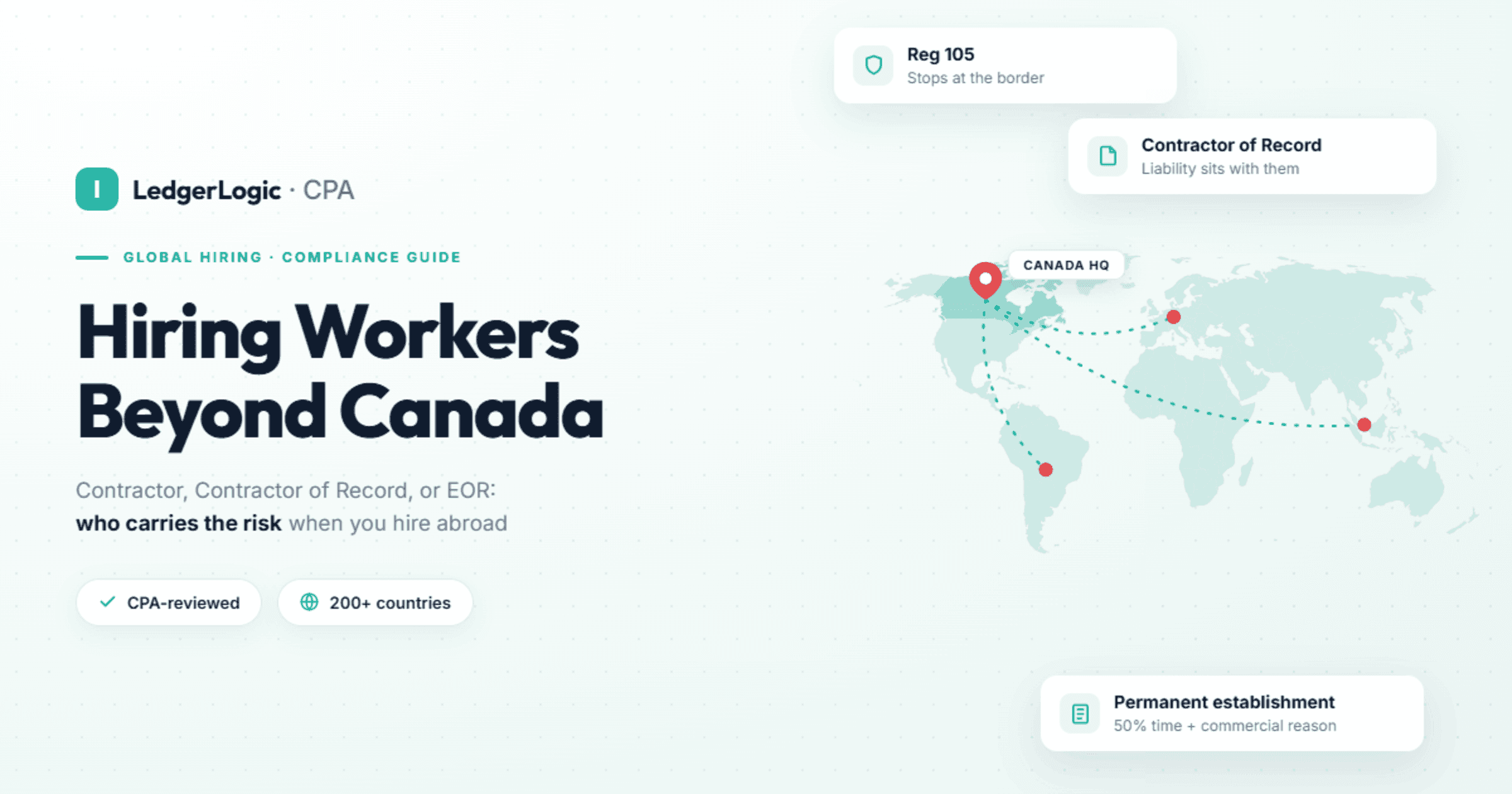
Many foreign companies start by paying a Canadian as an independent contractor to avoid the payroll setup. It is the single most common compliance error we see. Calling someone a contractor does not make them one: the CRA, provincial bodies, and the courts look at the real relationship, including control over the work, who provides the tools, the chance of profit and risk of loss, and how integrated the person is into your business.
If a worker who functions like an employee is treated as a contractor, you can be assessed for unremitted CPP, EI, and income tax, plus interest and penalties, and face employment-standards claims. Hiring through an EOR sidesteps the trap, because the worker is a properly classified employee of the EOR's Canadian entity from the start. We cover the slip-and-classification side in our Deel review.
Hiring in Quebec: a province that runs its own system
If your Canadian hire is in Quebec, treat it as a separate jurisdiction, because for payroll and employment purposes it nearly is.
- A parallel payroll system. Quebec uses the QPP instead of CPP, the QPIP for parental insurance instead of the federal EI parental benefit, the QHSF (Health Services Fund) for employers, and CNESST for workers' compensation and labour standards. Federal income tax and EI still go to the CRA, but provincial tax, QPP, QPIP, QHSF, and CNESST are remitted to Revenu Québec, and you issue an RL-1 slip in addition to the federal T4.
- French is the language of work. Under the Charter of the French Language (strengthened by Bill 96), offers of employment and individual employment contracts must be provided in French first; only after reviewing the French version can both parties agree to be bound in another language. This applies even when your company is based outside Quebec.
- Civil law, not common law. Quebec contracts are governed by the Civil Code, so templates written for the rest of Canada do not simply carry over.
This is exactly the kind of country-specific (and province-specific) complexity that trips up payroll systems and contract templates built for anywhere else.
When to build your own Canadian entity instead
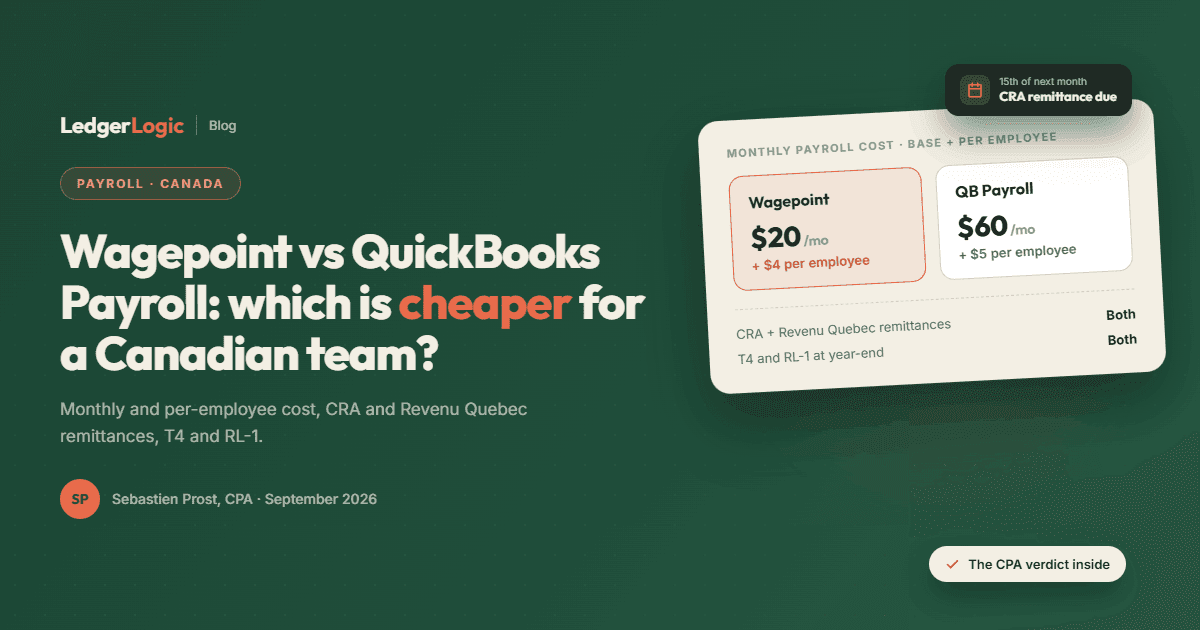
An EOR is not always the long-term answer. It makes sense when you want speed, have a small or uncertain Canadian headcount, or are testing the market. Setting up your own Canadian entity starts to win when the team is large and permanent, you want full direct control of employment and benefits, or the per-employee EOR fee begins to exceed the fixed cost of running your own entity and payroll. A rough rule of thumb: a handful of employees favours an EOR; a sizeable, settled Canadian team favours your own entity. If you go the entity route, you will run payroll yourself with a Canadian provider, and our Canadian payroll software guide and Wagepoint review cover the options.
How Deel handles Canada specifically
Because Deel owns its Canadian entity rather than renting a local partner, it can act as the legal employer directly, which matters for accountability and speed. For hiring into Canada, here is what that covers:
- It is the legal employer. Deel's Canadian entity employs your worker, so there is no third-party partner in the compliance chain and no entity for you to set up.
- It runs the full payroll stack. Deel registers and manages CPP, EI, provincial payroll and health tax accounts, and workers' compensation, then withholds and remits, and issues T4s, Quebec RL-1s, and the Record of Employment (ROE) on termination.
- Localized, compliant contracts. Employment agreements are drafted to the relevant province, including French-language contracts that meet Quebec's Bill 96 requirements, with in-house legal teams tracking federal and provincial law.
- Speed. Onboarding a Canadian employee through the owned entity is often about a day or two, rather than the weeks or months of standing up your own entity.
- Clean books. Payroll costs sync into Xero or QuickBooks, so reconciliation stays tidy at year end.
Hire your Canadian team in days, not months
Deel's owned Canadian entity handles CPP, EI, T4s, ROEs, provincial employment standards, and French-compliant Quebec contracts, so you can hire Canadians without incorporating in Canada.
Affiliate disclosure: LedgerLogic earns a commission if you sign up through our links, at no extra cost to you. We only recommend tools we would put in front of our own clients.
The CPA's bottom line
If you are a foreign company hiring one to a handful of Canadians, an Employer of Record like Deel is almost always the right first step: you are compliant in days, you skip the entity setup, and the province-by-province complexity is handled for you. Build your own Canadian entity once the team is large and permanent enough to justify the overhead. Whichever path you take, respect that Canada is not the United States: there is no at-will employment, termination carries real notice obligations, and Quebec is a world of its own. Get those three things right and hiring in Canada becomes routine.
Frequently Asked Questions
Can a US company hire an employee in Canada without a Canadian entity?+
How long does it take to hire in Canada through an EOR?+
How much does it cost to employ someone in Canada?+
Who issues the T4 and Record of Employment?+
Is employment in Canada at-will like the United States?+
What is different about hiring in Quebec?+
Does it matter if I pay a Canadian as a contractor instead?+

Sebastien ProstCPA, Ex-CRA
Licensed CPA with 10+ years of experience, including work with the Canada Revenue Agency. Founder of LedgerLogic, a cloud accounting firm serving Canadian SMEs. Xero Certified Advisor.