Disclosure: this post contains affiliate links. If you sign up through one, we may earn a commission at no extra cost to you. We only recommend tools a CPA has reviewed from the vendor's own pages.
Is Deel legit and worth it for a Canadian business?
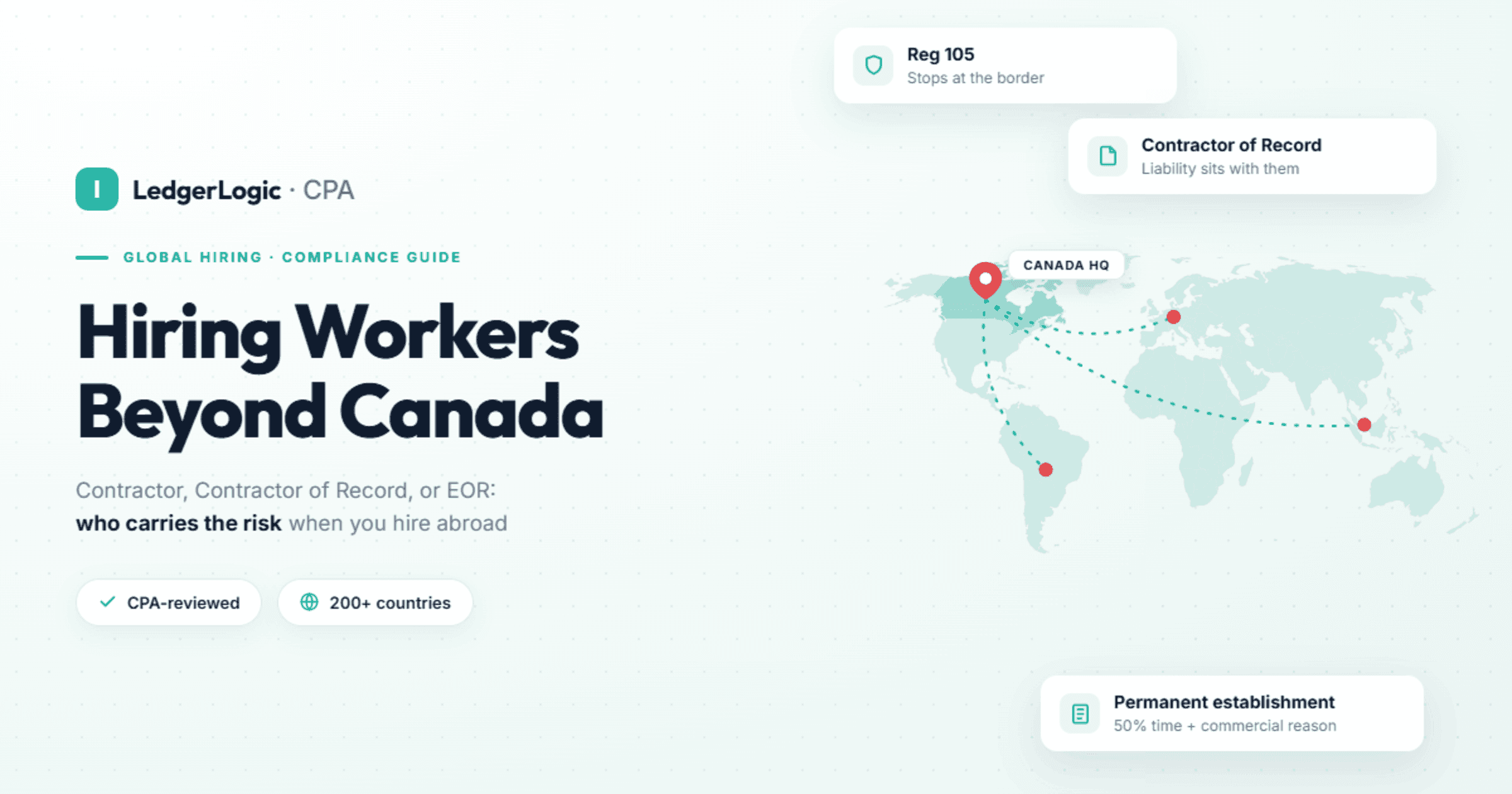
Deel is the right tool if your Canadian business pays contractors or hires employees in other countries. It handles compliant contracts, multi-currency payments, and local tax paperwork. Contractor management starts around $49 USD per worker per month and full Employer of Record hiring around $599 USD per employee per month. It is overkill for a Canada-only team, where a local payroll provider is cheaper. See Deel for yourself.
At a Glance
If you run a Canadian business and you have started paying a contractor in another country, or you are about to hire your first employee abroad, you have probably hit the same wall my clients do: the paperwork, the currency conversions, and the worry about whether any of it is compliant. Deel is built for exactly that problem. Here is my honest assessment as a CPA, including where it earns its price and where it does not.
What Deel actually does
Deel is a platform for hiring and paying people in other countries without setting up a legal entity in each one. In practice it covers three jobs:
- Contractor management: pay independent contractors abroad with compliant contracts and payments in 120-plus currencies.
- Employer of Record (EOR): hire a full employee in a country where you have no entity. Deel becomes the legal employer and handles the contract, payroll, taxes, and benefits.
- Global payroll: run payroll in countries where you already have an entity.
Who it is for, and who it is not
Deel makes sense for a Canadian business hiring beyond its borders: a software firm bringing on a developer in Poland, an agency paying a designer in Brazil, or a startup hiring its first employee in the UK. If you are building a distributed team, this is the category of tool you need.
It is not for paying your Canadian staff. If your whole team is in Canada, Deel is overkill, and you should use a domestic provider like Wagepoint instead. For a side-by-side of Canadian options, see our payroll software guide. Be honest about which situation you are in before you pay for anything.
What Deel looks like inside
To judge whether a platform earns its price, it helps to see how the day-to-day work is organized. Here is how Deel is laid out, the screens a Canadian business owner actually spends time in, and what each one is for.
The People view is the hub. Every worker you pay sits in one roster, tagged by location, team, and worker type (contractor, Deel EOR employee, or direct-payroll employee), with an onboarding or active status beside each name. For a business running a mixed team, say a contractor in Canada, a software engineer in the UK, and an EOR hire in Mexico, this single screen is where you confirm who is set up, who is still onboarding, and how many contracts are outstanding. Filters for worker status, worker type, and job title keep it usable once headcount climbs past a handful of people, and you can export the whole list as a report.
Each contractor gets their own contract and invoice page. Open a worker and you land on an Overview tab, with Contract Details, Time Off, Equipment, Stock Options, and Compliance and Documents alongside it. The money detail lives here: the approved amount for the period, the payment due date, and an itemized breakdown that separates the fixed monthly rate from one-off items like expenses or equipment. A running invoice history shows every prior period marked paid, which is exactly the kind of clean audit trail I want to see when a client hands me their books at year end. You approve and pay an invoice from this same screen, and there is a separate one-off payment option for anything outside the regular cycle.
Global Payroll is organized by country entity. If you run your own legal entities abroad, the payroll dashboard tracks each one as its own cycle with plain-language statuses, Awaiting Report Submission, Awaiting Approval, Awaiting Funding, and Completed, plus due dates and a red flag on any pay group with overdue items. A calendar grid lays out paydays and tasks across the month for each entity. This is the part that genuinely helps a finance lead juggling, for example, Canadian, German, and Japanese payrolls on different statutory deadlines, because the platform tells you what needs funding or approval before the date passes rather than after.
Everything routes through the left-hand menu: Contracts, Payments, Reports, Compliance and Documents, Tax Forms, Apps and Integrations, and Global Payroll each get their own section. Apps and Integrations is where the Xero and QuickBooks Online connections live, and Tax Forms is where the local paperwork Deel generates on your behalf is stored. None of it is hard to find, and that is the point: paying for a platform like this only makes sense if compliance and payment admin stop living in your inbox and start living somewhere your accountant can actually reconcile. For a CPA reviewing the result, that single design choice, putting payments, contracts, and tax forms in one auditable place, is most of the value.
What Deel costs
Pricing is set in US dollars, which matters for Canadian budgeting because your real cost moves with the exchange rate.
| Service | Starting price (USD) | Best for |
|---|---|---|
| Contractor management | ~$49 / contractor / mo | Paying freelancers and contractors abroad |
| Contractor of Record | ~$325 / mo | Adding a misclassification liability shield |
| Employer of Record | from ~$599 / employee / mo | Hiring employees where you have no entity |
| Global payroll | ~$29 / employee / mo | Running payroll in your own entities |
One caution: the EOR figure is the platform fee only. Salary, employer taxes, and statutory benefits sit on top and vary by country, and currency conversion and withdrawal fees add more. Model the all-in number in Canadian dollars before you commit.
Hiring or paying people internationally?
Deel handles compliant contracts, multi-currency payments, and local tax paperwork for contractors and employees in 150+ countries. See if it fits your situation.
What works well, and what stands out
After setting up Canadian businesses on global-payment tools, here is what genuinely earns Deel its reputation. Two things stand out: the depth of its compliance and legal coverage, and how cleanly it plugs into your accounting.
- Compliance is genuinely handled. Localized contracts, in-house legal teams in 130-plus countries, and SOC 2, ISO 27001, and GDPR certification. That removes the part of global hiring that keeps business owners up at night.
- It plugs into your books. Deel integrates with Xero and QuickBooks Online, so contractor payments flow into your accounting instead of living in a spreadsheet. This is where most do-it-yourself global-payment setups fall apart.
- It is fast. Contractor onboarding takes minutes, and Canadian employee onboarding through EOR is often about a day.
- The market trusts it. Roughly 4.8 on G2 and 4.9 on Capterra across tens of thousands of reviews.
Where it falls short
- The all-in price is bigger than the sticker. The $599 EOR figure is the platform fee only. Salary, employer taxes, statutory benefits, and FX fees stack on top. For a single contractor you pay occasionally, $49 per month may not be worth it.
- Support is chatbot-first. The in-app chat tends to open with scripted answers and help-centre links, and you sometimes have to ask for a human. Response times also stretch during peak payroll periods. Once you reach a person, the help is solid and knowledgeable on country-specific rules.
The part most reviews skip: the Canadian tax angle
This is where a CPA can save you from an expensive mistake.
- Misclassification risk is still yours to manage. Paying someone as a contractor does not make them one. Deel's Contractor of Record and EOR products shift that liability, but you still need the working relationship to be correct. The CRA tests this for Canadian workers, and other countries apply their own tests.
- Know which tax slip applies. A T4A is for Canadian-resident contractors, not foreign ones. A contractor in another country does not receive a T4A; Deel generates the correct local paperwork instead. Filing the wrong form, or assuming you owe one when you do not, is a common error.
- Reconciliation matters at year end. Because Deel pushes payments into Xero or QuickBooks, your contractor costs are clean and categorized at filing time rather than a pile of wire transfers to untangle.
Where Deel fits in the market
The global-hiring category has a handful of serious players, Remote, Rippling, Oyster, and Papaya among them. Deel's position is the broad all-in-one: it covers contractor payments, EOR, and global payroll under one roof, with one of the deepest integration libraries (including Xero and QuickBooks) and in-house legal teams in 130-plus countries. Rippling leans toward an all-in-one HR and IT suite, while Oyster and Papaya skew to pure EOR. For a Canadian small business that wants one platform to start with contractors and grow into employees abroad without switching tools later, Deel is usually the most complete fit. It is rarely the cheapest, and that is the trade-off.
My verdict
For a Canadian business that has crossed into hiring or paying people abroad, Deel is the most complete option in its category, and the compliance and bookkeeping integration are what justify the cost. For a domestic-only team, skip it. The honest dividing line is whether you have two or more international workers, or want the compliance shield for even one.
See if Deel fits your business
Compliant contracts, multi-currency payments, and local tax paperwork for contractors and employees in 150+ countries.
Affiliate disclosure: LedgerLogic earns a commission if you sign up through our links, at no extra cost to you. We only recommend tools we would put in front of our own clients.
Frequently Asked Questions
Is Deel worth it for a small Canadian business?+
How much does Deel cost in Canada?+
Do I issue a T4A for contractors paid through Deel?+
Deel or Wagepoint for my payroll?+
Does Deel integrate with Xero and QuickBooks?+
Contractor management or EOR, which do I need?+
Is Deel safe and legitimate?+

Sebastien ProstCPA, Ex-CRA
Licensed CPA with 10+ years of experience, including work with the Canada Revenue Agency. Founder of LedgerLogic, a cloud accounting firm serving Canadian SMEs. Xero Certified Advisor.