Disclosure: this post contains affiliate links. If you sign up through one, we may earn a commission at no extra cost to you. We only recommend tools a CPA has reviewed from the vendor's own pages.
Is Brex available to Canadian businesses?
No. Brex is not available to Canadian businesses: Brex states that every applicant needs a US EIN issued by the IRS, a valid US incorporation, US operations and a US physical address (Brex account requirements page and legal FAQ, read 18 September 2026). The Canadian answers are Ramp, the closest match to Brex, with CAD and USD cards, a fixed 1% cashback and US$500 after US$1,000 of card spend through our link (corporations only, CA$25,000 across linked accounts, not in Quebec or the territories), and Float, Canadian-built, paying 2.5% on CAD and 2.75% on USD balances, with the Professional plan free for 12 months through our link.
At a Glance
If you have looked at US startup finance stacks, you have probably seen Brex, the corporate card and spend platform used by thousands of venture-backed US companies. The natural question for a Canadian founder is simple: can I use Brex in Canada? The short answer is no. This guide explains why, who the narrow exceptions are, and which Canadian alternatives actually do the job.
Is Brex available in Canada?
No. Brex is not available to Canadian-incorporated businesses. To open a Brex account you need a US-incorporated entity (a US C-corp or LLC), a US Employer Identification Number (EIN), and US operations or a US address. A company incorporated only in Canada, with a Canadian business number, cannot open a Brex account, issue cards to a Canadian entity, or use CAD tools.
This is a deliberate product decision, not a temporary gap. Brex underwrites and operates inside the US banking system, and as of 2026 there is no Canadian version of the product.
Who can actually use Brex (the narrow exception)
There is one path. If your Canadian business has set up a US subsidiary or entity with its own EIN and US operations, that US entity can apply for Brex. This is common for Canadian SaaS companies expanding into the US, or startups that incorporated in Delaware to raise from US investors. If that is you, Brex is a legitimate option for the US entity, but you will still need a Canadian solution for your Canadian operating company.
For everyone else, a Canadian company running on CAD, the answer is to use a platform built for Canada.
The Closest Thing to Brex in Canada
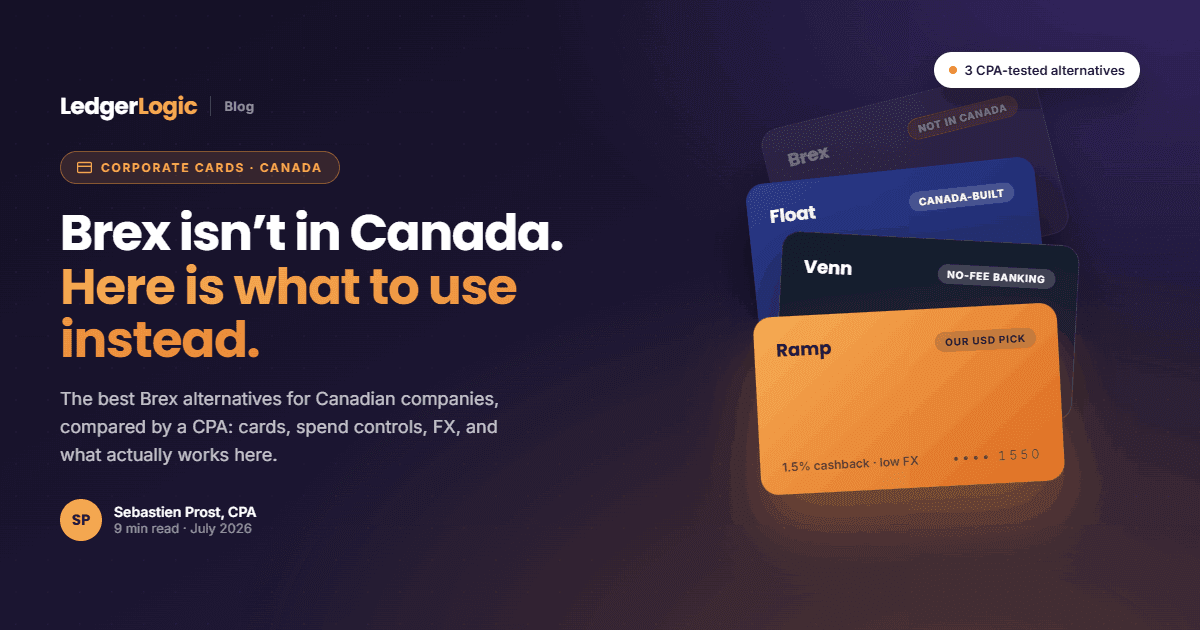
Ramp gives Canadian businesses CAD and USD cards, 1% cashback, and $500 USD after $1,000 of spend, no US entity required.
The best Brex alternatives in Canada
Three platforms cover what Canadian businesses actually want from Brex, corporate cards, spend controls, and clean accounting sync, without needing a US entity.
1. Ramp, the closest Brex equivalent for Canada
Ramp is the platform most like Brex, and it now serves Canadian businesses directly. It issues both CAD and USD cards (through Peoples Trust, an OSFI-regulated Canadian trust), auto-codes GST/HST/PST, and syncs to Xero, QuickBooks, and NetSuite in Canadian dollars. The core platform is free, it pays 1% cashback, and new accounts get US$500 after US$1,000 of card spend through our partner link; the terms and who qualifies are on our Ramp sign-up bonus page. If you want the Brex experience, Ramp is the closest thing available to Canadians, and it is especially strong if you carry USD software and advertising spend.
2. Float, the Canadian-built option
Float is built in Canada for Canadian businesses. It offers CAD and USD corporate cards, interest on idle cash (2.5% on CAD and 2.75% on USD as of September 2026, variable), 1% cashback on card spend above $25,000 a month in each currency, and a clean Xero and QuickBooks integration. New customers get the Professional plan free for 12 months through our link. For a purely CAD-first business, Float is often the smoother day-to-day experience.
3. Venn, if you want a full business account
Venn is a no-monthly-fee Canadian business account with corporate cards, multi-currency accounts, and low FX. It is less of a spend-automation platform than Ramp or Float and more of a bank-account replacement, useful if you want CAD and USD accounts plus cards in one place. Registered corporations can earn up to $500 based on card spend through our referral link.
Want cards on the same system as payroll and HR? Rippling sells a Visa corporate card in Canada, issued by Peoples Trust Company, on its own or as part of its Spend suite, alongside its HR and payroll products; the card launched in Canada without Quebec. Canadian-dollar purchases at Canadian merchants carry no fees or interest, purchases in a foreign currency or with merchants abroad carry fees, there is no personal credit check or guarantee, and sole proprietorships are not eligible (from Rippling's Canadian card page). There is no Rippling referral link in this post. See our Rippling Canada review.
Brex vs Ramp vs Float vs Venn
| Feature | Brex | Ramp | Float | Venn |
|---|---|---|---|---|
| Available in Canada | No | Yes | Yes | Yes |
| Requires US entity + EIN | Yes | No | No | No |
| Cards | USD (US) | CAD + USD | CAD + USD | CAD + USD |
| Cashback | Points (US) | 1% uncapped | 1% over $25K/mo of card spend per currency | 1%, capped at $5K/mo of spend on the free plan |
| Signup offer | US-only | $500 after $1k spend | Pro free 12 months | Up to $500 (corporations) |
| Best for | US-incorporated startups | USD-heavy / cross-border | CAD-first SMEs | Business account + cards |
Which should you choose?
- Want the Brex experience with USD spend? Use Ramp: CAD and USD cards, 1% cashback, and the $500 bonus.
- Purely CAD-first? Use Float: Canadian-built, yield on idle cash, free Pro for 12 months.
- Want a full business account, not just cards? Use Venn.
- Actually have a US entity? Brex is fine for the US entity, but you still need one of the above for your Canadian company.
For most Canadian businesses, the real decision is Ramp vs Float. Our Float vs Ramp comparison walks through that choice in detail, and our spend management guide covers the category.
Ramp vs Brex for a Canadian company
Ramp, because it is the only one of the two that will open an account for a Canadian corporation. Ramp's Canadian eligibility page states that Ramp "is available for businesses legally registered in Canada, with no US entity required", while Brex requires a US EIN, a valid US incorporation, US operations and a US physical address. Feature for feature, Ramp Canada gives you most of what Brex gives its US customers: a free platform, unlimited Visa cards in CAD (physical and virtual) and USD (virtual only) issued by Peoples Trust Company, a fixed 1% cashback on all eligible spend, GST, HST and PST coding as transactions are coded into QuickBooks Online, Xero, NetSuite or Sage Intacct, and a charge card with no personal guarantee. The gates are ones Brex does not have: your business must be a corporation, incorporated partnership or not-for-profit (sole proprietors are not eligible), your connected bank accounts must show at least CA$25,000, and Ramp does not serve Quebec, Yukon, the Northwest Territories or Nunavut. Through our Ramp link a new account gets US$500 after US$1,000 of card spend. The full read is in our Ramp Canada review, and Ramp vs Venn covers the case where you also want a bank account.
Float vs Brex: what a Canadian business gets instead
Float, because Brex will not open an account for a Canadian corporation and Float is built in Canada for exactly that company. Brex requires a US EIN, US incorporation, US operations and a US physical address. Float's pricing page (read 25 September 2026) lists physical and virtual cards in CAD and USD, 0.25% to convert between CAD and USD inside the account, 1% cashback only on card spend above $25,000 a month per card program, Essentials at $0 per user and Professional from $100 a month with 10 active users included, and its business account pays 2.5% on CAD and 2.75% on USD balances. So the useful comparison is what Brex offers its US customers against what Float offers here.
| Brex (US companies only) | Float (Canadian companies) | |
|---|---|---|
| Who can open it | US entity with an EIN | Registered Canadian or US business, including sole proprietors registered federally or provincially |
| Cards and currencies | USD cards | Visa in CAD and Mastercard in USD, virtual and physical |
| Platform fee | Free tier plus paid plans | Essentials $0 per user; Professional from $100 a month with 10 active users, then $10 per additional active user, free for 12 months through our link |
| Credit | Charge card sized on cash and revenue | Float Charge: interest-free, unsecured, up to $3M and more, no personal guarantee, for partnerships and corporations that are profitable or hold 12 months of operating funds, with $50,000 in cash; otherwise pre-funded |
| Yield and FX | Treasury yield on USD balances | 2.5% on CAD and 2.75% on USD balances; 0.25% to convert CAD and USD in the account, 2.5% on card purchases in another currency |
| Protection | US FDIC sweep | RPAA-registered payment provider, funds in trust at Scotiabank, CDIC to $100,000 combined across CAD and USD |
The short version for a Canadian owner who liked the look of Brex: Float gives you the same operating model, cards issued against your own cash or an interest-free credit line, with CAD and USD business accounts, Canadian tax coding and CDIC coverage on funds held in trust. The full breakdown is in our Float review.
Does a Canadian company need an EIN, and how do you get one?
Only if it has a US tax filing or reporting obligation, and holding one does not make it eligible for Brex. An Employer Identification Number is the IRS's taxpayer number for businesses. A Canadian corporation typically needs one when it has to file a US return, such as Form 1120-F, which the IRS describes as the form a foreign corporation files to report its income and figure its US income tax liability, or when a US payer, bank or platform requires a US taxpayer identification number. Getting one is free (the IRS states you never have to pay a fee for an EIN). A company whose principal place of business is outside the United States cannot use the IRS online application; it completes Form SS-4 and applies by telephone at 267-941-1099 (not toll-free, 6:00 a.m. to 11:00 p.m. Eastern, Monday to Friday), by fax, or by mail, per the IRS instructions for Form SS-4. The EIN identifies the Canadian corporation for US tax purposes only. Brex asks for a US EIN and a valid US incorporation, US operations and a US physical address, so a Canadian corporation with an EIN still does not qualify; only a US-incorporated subsidiary would. For what triggers US filings in the first place, see our guide to the Canada-US tax treaty.
Alternatives to big-bank corporate cards for Canadian SMBs
Four fintech platforms replace a CIBC, RBC, TD, BMO or Scotiabank corporate card for a Canadian SMB, and none charges a monthly fee on its entry plan: Float, Ramp, Venn and Loop. The deciding question with a bank card is usually liability: TD and BMO make a business’s owners personally liable for the card, and Float, Ramp and Venn ask for no personal guarantee. We compare the bank cards term by term, with what moving the spend involves, in Float vs Amex and bank corporate cards. Ramp, Float and Venn are covered above, and Loop is in our Loop review.
The whole category, with eligibility by province, is on our spend management hub and business banking hub.
Frequently Asked Questions
Is Brex available in Canada?
No. Brex requires US incorporation with an EIN and US operations, so a company based only in Canada cannot open a Brex account or issue Canadian cards. Canadian businesses use Ramp, Float, or Venn instead.
Why can't Canadian businesses use Brex?
Brex operates inside the US banking system and underwrites US entities. Without a US-incorporated company, a US EIN, and US operations, you cannot be approved.
What is the best Brex alternative in Canada?
Ramp is the closest equivalent: CAD and USD cards, 1% cashback, and a $500 USD signup bonus. Float is the best Canadian-built option, and Venn is the pick if you want a full business account rather than a spend platform.
Can I use Brex with a US subsidiary?
Yes. If your Canadian business has a US entity with its own EIN and US operations, that US entity can apply for Brex. You will still need a Canadian solution (Ramp, Float, or Venn) for your Canadian operating company.
Is Ramp available in Canada?
Yes. Ramp issues CAD and USD cards to registered Canadian businesses via Peoples Trust, auto-codes GST/HST/PST, and syncs to Xero and QuickBooks in CAD. New accounts get US$500 after US$1,000 of card spend through a partner link.
Ramp or Float for a Canadian business?
Ramp is best for USD-heavy or cross-border spend and carries the $500 bonus. Float is best for CAD-first businesses, with yield on idle cash and a free 12-month Professional plan. See our Float vs Ramp comparison.
Ramp vs Brex: which one can a Canadian company use?
Ramp. Its eligibility page says it is available to businesses legally registered in Canada with no US entity required, while Brex requires a US EIN, US incorporation, US operations and a US physical address. Ramp Canada gives a Canadian corporation CAD and USD Visa cards, a fixed 1% cashback and US$500 after US$1,000 of card spend through our link, provided it is a corporation outside Quebec and the territories with CA$25,000 across linked accounts.
Float vs Brex: which is better for a Canadian business?
Float, because Brex will not open an account for a Canadian corporation. Float is Canadian-built, issues Visa cards in CAD and Mastercard cards in USD, charges 0.25% to convert between CAD and USD inside the account, pays 2.5% on CAD and 2.75% on USD balances, and the Professional plan is free for 12 months through our link.
Does a Canadian company need an EIN, and how does it get one?
Only if it has a US tax filing or reporting obligation, such as Form 1120-F. The EIN is free; a company whose principal place of business is outside the United States cannot use the IRS online application and instead completes Form SS-4 and applies by phone at 267-941-1099, by fax or by mail. Holding an EIN does not make a Canadian corporation eligible for Brex, which also requires US incorporation, US operations and a US physical address.
What are the alternatives to CIBC, RBC or TD corporate cards for a Canadian SMB?
Float (Canadian-built, CAD and USD cards, 0.25% CAD/USD conversion in the account, 2.5% on CAD and 2.75% on USD balances, Professional free for 12 months through our link), Ramp (the closest thing to Brex, fixed 1% cashback, US$500 after US$1,000 of card spend through our link, corporations outside Quebec and the territories), Venn ($0 a month account whose card pays 1% cashback on up to $5,000 of spend a month on the free plan; not in Quebec) and Loop (multi-currency account, Basic $0 a month with 0.47% FX). None charges a monthly fee on its entry plan.

Sebastien ProstCPA, Ex-CRA
Licensed CPA with 10+ years of experience, including work with the Canada Revenue Agency. Founder of LedgerLogic, a cloud accounting firm serving Canadian SMEs. Xero Certified Advisor.