Disclosure: this post contains affiliate links. If you sign up through one, we may earn a commission at no extra cost to you. We only recommend tools we use with our own clients.
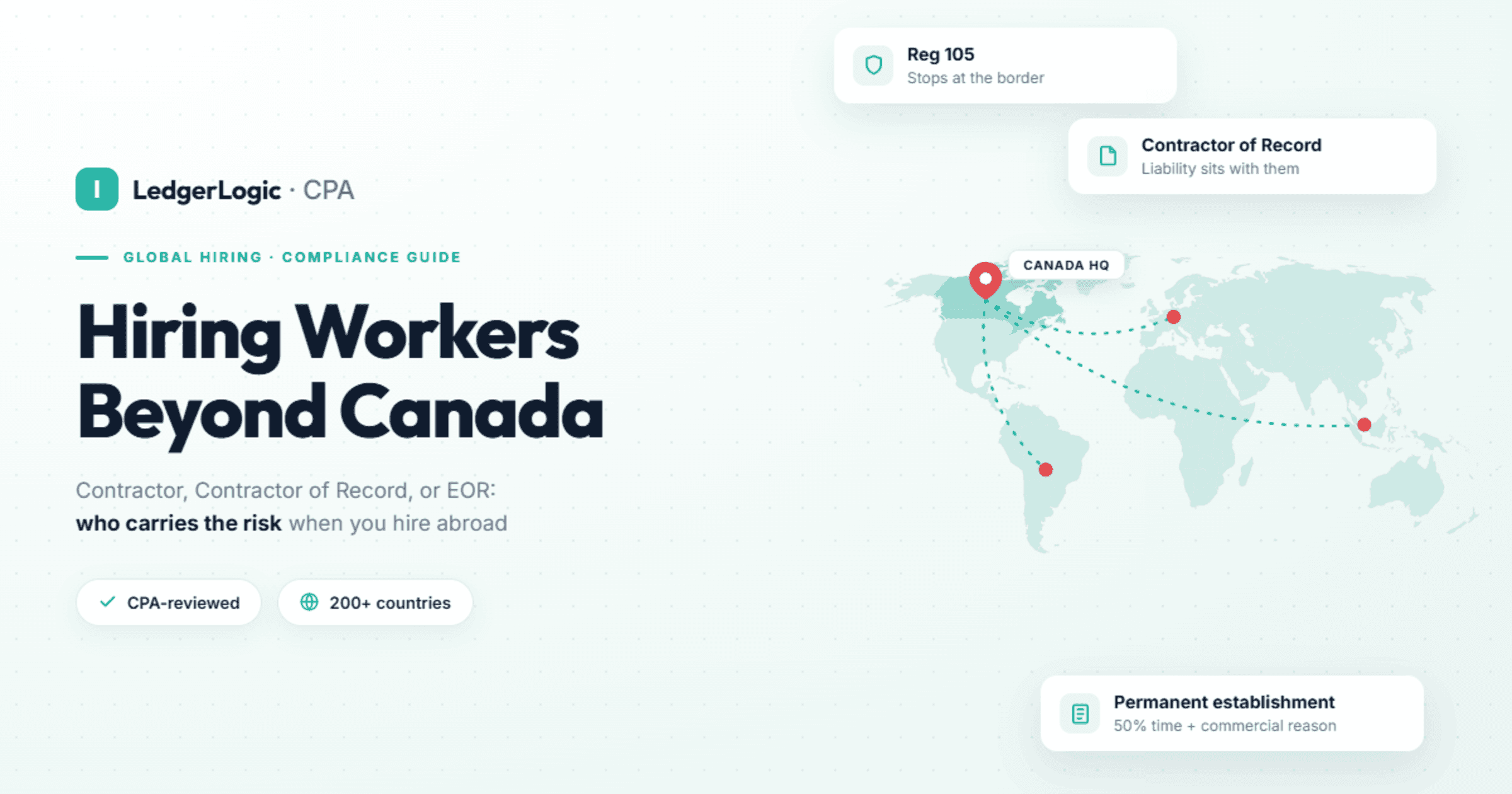
When a Canadian business pays someone who lives and works in another country, the Canadian tax side is usually quiet: Regulation 105 withholding applies only to services rendered in Canada, so work performed abroad is outside it, and no T4A-NR is required. The exposure sits in the other country instead, in two places: worker misclassification under local labour law, and permanent establishment risk, which the OECD tightened in November 2025. How you engage the worker, direct contract, Contractor of Record, or Employer of Record, decides who carries that risk.
At a Glance
The question I get from Canadian founders is almost always the same, and it is almost always the wrong one. They have found a developer in Portugal or a designer in Colombia, they are about to send the first payment, and they want to know what they have to withhold and remit to the CRA.
The usual answer is nothing. Canada is rarely where this goes wrong. The rules that bite are in the other country, they are labour rules rather than tax rules, and by the time anyone notices, the relationship has often been running for two years.
Here is what actually applies, on both sides of the border, and how to decide between engaging someone directly, using a Contractor of Record, and putting them on an Employer of Record.
1. What Canada Actually Asks of You
Most of the Canadian anxiety here traces back to Regulation 105, the 15 per cent withholding on payments to non-residents. It is worth reading the actual wording, because the scope is narrower than people assume. Section 105 of the Income Tax Regulations requires that:
Every person paying to a non-resident person a fee, commission or other amount in respect of services rendered in Canada, of any nature whatever, shall deduct or withhold 15 per cent of such payment.
The operative words are "rendered in Canada." The CRA is explicit in Information Circular IC75-6R2 that where a non-resident performs services both inside and outside Canada, payments for the portion performed outside Canada are not subject to Regulation 105 withholding, and a reasonable allocation is required to split the two.
So a developer sitting in Lisbon, working on your product from Lisbon, is not rendering services in Canada. There is no 15 per cent to withhold. If that same developer flies to Toronto for a two-week onsite, the portion of the fee attributable to those two weeks is in scope, and that is the situation our guide to the difference between Regulation 105 and Regulation 102 deals with.
The reporting follows the same logic. The T4A-NR slip is titled "Payments to Non-Residents for Services Provided in Canada," and that title is the test. Services provided outside Canada do not generate one. Nor does your foreign contractor get a T4A, which is a slip for residents. There is no CPP and no EI, because neither applies to a non-resident performing work outside the country.
What you do still owe Canada is unglamorous: keep a real contract, keep proof the work happened, and be able to show the amount is a reasonable business expense. If the arrangement is ever challenged, the challenge will be about deductibility and documentation, not withholding.
One thing that does travel: GST and HST on services you buy from abroad can create self-assessment obligations depending on your registration status and the use of the service. That is a separate question from payroll, and we cover the mechanics in our guide to GST/HST on remote services.
2. Where the Real Exposure Sits
Having established that Canada is mostly quiet, here is the part that is not.
Misclassification, judged by their rules
Every country has its own test for whether a worker is genuinely independent or is really an employee wearing a contractor label. Canadian business owners tend to reason from the CRA's factors, control, tools, chance of profit, risk of loss, integration, because that is the framework they know from the employee versus contractor question at home. Those factors are irrelevant abroad. What governs is the labour law where the person actually sits.
Several of those regimes are considerably stricter than Canada's. Some presume employment once a worker derives most of their income from a single client. Others weigh fixed hours, or the provision of equipment, far more heavily than the CRA does. The practical result is that an arrangement that would comfortably survive a CRA review can still be reclassified in the worker's country.
When that happens, the bill is not a tax bill. It is back-dated statutory entitlements: unpaid social contributions with interest, holiday pay, thirteenth-month payments where those exist, notice, and severance. It is assessed against you as the deemed employer, in a jurisdiction where you have no entity, no local counsel, and no ability to argue Canadian law.
Permanent establishment, and a rule that just changed
The second exposure is corporate rather than employment-related. If your business is treated as having a permanent establishment in the other country, a share of your profits becomes taxable there, and you inherit filing obligations you did not plan for.
This is the area worth paying attention to right now, because the OECD updated its Model Tax Convention commentary on 19 November 2025 with a specific framework for home-office permanent establishment. It sets a two-part test, and both parts have to be met:
- Time. The person works from a home office in that country for at least 50 per cent of their working time across any rolling twelve-month period.
- Commercial reason. There is a business rationale for their presence there, such as regular dealings with local clients or suppliers, or activity that materially advances your business in that market.
The second limb is the useful one. The commentary is clear that arrangements driven purely by employee preference, talent retention, or saving on office space do not supply a commercial reason. A Canadian company whose backend engineer happens to live in Spain, serving only Canadian customers, is in a materially better position than one whose salesperson lives in Spain and sells to Spanish accounts. Same headcount, same country, different answer.
Note that this analysis is about your corporate footprint, and it runs separately from the classification question. You can get classification right and still create a permanent establishment.
Hiring in a Country You Do Not Have an Entity In
Deel classifies the worker against local rules, generates a compliant local contract, and can act as Contractor of Record so the misclassification liability sits with them rather than you. It covers contractors in 200+ countries and jurisdictions.
3. What Employing Someone Abroad Costs
Founders often discover that the contractor route was never really optional, because the alternative is more expensive than they modelled. Three costs are routinely missed.
Employer contributions. These sit on top of salary and vary enormously. In France the employer share runs to roughly 42 to 45 per cent of gross pay, per PwC's Worldwide Tax Summaries. In Germany the employer's social security share is closer to 20 per cent. Brazil's combined contributions are around 31 per cent. A budget built on Canadian CPP and EI rates, which together cost an employer a single-digit percentage of salary, will be wrong by a wide margin.
Entity and payroll registration. Employing someone directly generally means a local entity, a local payroll registration, a local bank account, and ongoing statutory filings. This is a months-long and lawyer-heavy exercise, and it rarely makes sense below a handful of people in one country.
Termination. At-will employment is close to a North American peculiarity. In much of Europe and Latin America, dismissal requires cause, notice on a statutory scale, and severance, and getting it wrong can mean reinstatement rather than damages. The cost of ending the relationship needs to be priced before it starts, and it is the single most common surprise for Canadian employers hiring into the EU.
None of this argues against hiring abroad. It argues against hiring abroad on the assumption that it works like hiring in Ontario. If your situation is the reverse, a foreign company hiring into Canada, the mirror-image walkthrough is in our guide to hiring employees in Canada as a foreign company.
4. Your Four Routes
There are really only four ways to do this, and they run in ascending order of protection and cost.
1. Contract with them directly. You draft an agreement, you pay by transfer, you keep the invoices. Cheapest and fastest. You carry the entire classification risk yourself, in a legal system you do not know, and you are responsible for making sure the contract is enforceable and locally compliant. Defensible for genuinely independent, short-term, project-based work with several clients in the mix.
2. Use a contractor management platform. The platform generates locally-appropriate contracts, runs classification assessments, handles invoicing and payment in local currency, and keeps the paper trail. The compliance risk still rests with you, but you are making the decisions with better information and better documentation. Deel covers this across 200+ countries and jurisdictions, with 120+ currencies and 15+ payout options.
3. Contractor of Record. A third party contracts the worker through its own entity and takes on the liability. Deel's Contractor of Record product classifies the worker with local experts, engages them through a Deel entity, and assumes the indemnification. Onboarding runs up to about seven days, and pricing is structured as a deposit of one month of the contractor's payment plus a Deel fee. This is the option for a long-running contractor relationship you are not comfortable defending yourself.
4. Employer of Record. If the relationship is genuinely employment, stop trying to make it a contract. An EOR employs the person through its own local entity, runs statutory payroll and benefits, and handles termination under local rules. You direct the work; they carry the employment. It costs more per head than a contractor arrangement and far less than standing up an entity. Our Deel versus Remote comparison works through the two largest options for Canadian businesses, and the full Deel review covers the platform in detail.
Worth knowing: if a relationship is put forward for Contractor of Record and the classification assessment says it is really employment, the answer is not to proceed anyway. Deel routes those to its EOR product instead, which is the correct outcome even though it is the more expensive one.
5. How to Choose
Three questions settle it in most cases.
Is this person functionally an employee? Set hours, your equipment, your direction, no other clients, indefinite term. If most of that is true, they are an employee in substance, and the only real choice is between an EOR and your own entity. Labelling them a contractor does not change the answer, it just defers the reckoning.
How long is this running? A three-month project sits comfortably in a direct contract. A relationship entering its third year, full-time, is the classic misclassification profile and belongs in Contractor of Record or EOR.
Is there a commercial reason for them being in that country? If they deal with local clients or suppliers, or their presence advances your business in that market, you are in permanent establishment territory once the 50 per cent time threshold is met. That is a conversation to have with a cross-border advisor before the arrangement is a year old, not after.
On payroll for the people you employ in Canada, none of this changes anything: that remains a domestic question, and our comparison of the best Canadian payroll software covers it.
6. The Bottom Line
Canadian businesses hiring abroad tend to over-worry about the CRA and under-worry about everything else. Regulation 105 stops at the border, there is no slip to file for work performed outside Canada, and the withholding question that prompted the whole exercise usually has a one-word answer.
The risk that matters is in the other country: whether their labour law agrees that your contractor is a contractor, and whether the person's presence has quietly given you a taxable footprint there. Both are manageable, and both are much cheaper to manage before the relationship is established than after.
If you are engaging contractors in countries where you have no entity and no local counsel, a platform that classifies the worker against local rules and can take on the liability itself is doing real work, not just moving money. See how Deel handles contractor classification across 200+ countries and jurisdictions.
If you want a second opinion on a specific arrangement, particularly the permanent establishment question, that is worth a conversation with a CPA who works on cross-border files before you sign anything.
Frequently Asked Questions
Do I withhold 15 per cent when paying a foreign contractor?
Does a foreign contractor get a T4A or a T4A-NR?
What is the actual risk if I just pay a foreign contractor directly?
What is permanent establishment, and when does a remote worker create one?
What is the difference between Contractor of Record and Employer of Record?
How much more does it cost to employ someone abroad versus contracting them?
Do I need to open a company in the other country?
Does any of this change how I run Canadian payroll?

Sebastien ProstCPA, Ex-CRA
Licensed CPA with 10+ years of experience, including work with the Canada Revenue Agency. Founder of LedgerLogic, a cloud accounting firm serving Canadian SMEs. Xero Certified Advisor.