Disclosure: this post contains affiliate links. If you sign up through one, we may earn a commission at no extra cost to you. We only recommend tools we use with our own clients.
What does an AI hiring stack look like for a Canadian business in 2026?
AI now runs sourcing, screening and ranking in most hiring teams, but the 2026 rulebook is not what the headlines said. The EU AI Act's high-risk employment obligations were deferred from 2 August 2026 to 2 December 2027, and Colorado's AI Act moved to 1 January 2027 in a scaled-back form. What is actually in force today is disclosure: Ontario has required AI disclosure in job postings since 1 January 2026 for employers with 25 or more employees, Illinois HB 3773 since the same date, and New York City has required annual bias audits since 2023. Canada has no AI statute, because AIDA died with Bill C-27 in January 2025.
The quick version
Every hiring team I talk to has quietly rebuilt the top of its funnel around AI in the last eighteen months. The numbers back the anecdote: a June 2026 survey of 1,500 US hiring managers found 87% of companies now use AI somewhere in recruiting, up from 82% a year earlier, and the share screening resumes with AI jumped from 35% to 58% in a single year. Job descriptions are drafted by a model, applications are parsed and ranked automatically, and a chatbot handles the first screen before a human reads a single CV. That part is settled. What is not settled is who carries the liability when the machine is wrong, and the answer changed twice this year in ways most 2026 planning decks have not caught up with.
This is a breakdown of the AI hiring stack as it actually exists in 2026: what each layer does, which rules genuinely bind you today, which deadlines quietly moved, and where the financial exposure sits once a candidate becomes a paid worker in another country. I write this as a CPA who cleans up the payroll and tax consequences after the hiring decision is made, which is a different vantage point from the recruiting side and tends to surface different risks.
The four layers of the 2026 AI hiring stack
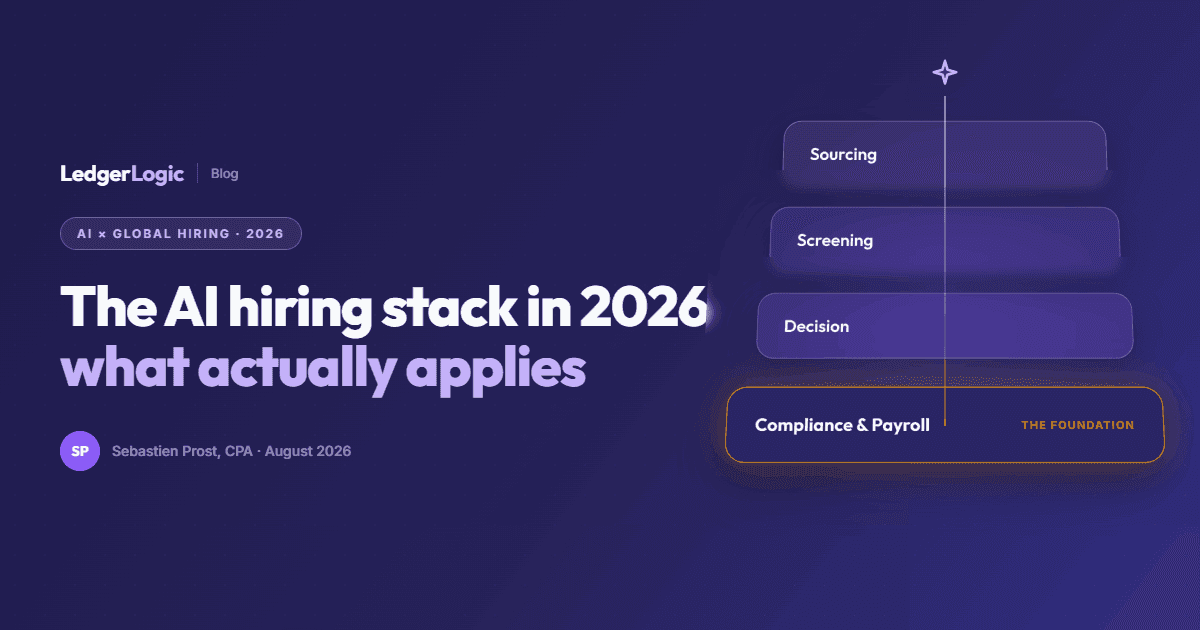
It helps to separate the stack into layers, because the regulation lands on some and not others, and the vendors are rarely the same.
- Layer 1, sourcing and outreach. Models write postings, find candidates and personalise outreach. Lightly regulated so far, with one important Canadian exception covered below.
- Layer 2, screening and ranking. Resume parsing, scoring, shortlisting and automated video interview review. This is the layer regulators actually care about, because it is where a model can systematically exclude a protected group at scale.
- Layer 3, the decision. Interview scheduling, structured scorecards, reference checks, offer modelling. Human sign off usually re-enters here, though often as a rubber stamp on a machine-produced ranking.
- Layer 4, the employment relationship. The moment the offer is accepted, an abstract candidate becomes a real payroll and tax obligation in a specific jurisdiction. Classification, local contracts, statutory benefits, payroll withholding, permanent establishment risk and data residency all attach here.
Almost all of the public conversation is about Layer 2. Almost all of the money that goes wrong is in Layer 4. Holding both in view at once is the whole point of this piece.
Two deadlines moved, and the decks have not caught up
If your compliance plan was written in 2025, it very likely contains two dates that are no longer correct.
The EU AI Act high-risk employment obligations were deferred. Recruitment and employee management systems sit in Annex III, which makes them high risk, and those obligations were scheduled to apply from 2 August 2026. They no longer do. The Digital Omnibus was published in the Official Journal on 24 July 2026 and entered into force on 27 July 2026, pushing the Annex III application date to 2 December 2027, per DLA Piper's tracking of the file. This is enacted law, not a proposal.
Colorado moved twice and then shrank. The Colorado AI Act was the first broad US state law aimed at high-risk AI in employment decisions. Its original 1 February 2026 start was pushed to 30 June 2026, and then SB 189, signed 14 May 2026, moved it again to 1 January 2027 while cutting much of its substance, including the duty of care around algorithmic discrimination and the deployer impact-assessment obligations. Hunton and Akin both track the sequence. What remains is closer to a disclosure and transparency regime than the risk-management framework originally passed.
The temptation is to read those two as a reprieve. That reading is wrong, and it is wrong in an expensive way, because the rules that took effect while everyone was watching Brussels and Denver are the ones that apply to ordinary employers right now.
Hiring Across Borders Without a Local Entity
Deel acts as Employer of Record through its own local entities, tests contractor classification against local rules before the contract is signed, and runs payroll and withholding in each country. It is the layer that carries the liability the screening tools never touch.
Three rules that are actually in force today
Ontario, since 1 January 2026. Amendments to the Employment Standards Act require that a publicly advertised job posting disclose whether AI is used to screen, assess or select applicants. It applies to employers with 25 or more employees on the day the posting is made, and it reaches the ordinary tools people forget are AI: a resume parser that ranks applicants, a chatbot that pre-screens, any system that scores or shortlists. Littler and Osler have both written on the practical scope. This is the single most commonly missed obligation I see, because it binds companies that do not think of themselves as AI users at all.
Illinois, since 1 January 2026. HB 3773 amends the Illinois Human Rights Act to prohibit AI that has the effect of discriminating on a protected basis across recruitment, hiring, promotion, discipline and discharge. It adds a notice requirement when AI is used, and bans using zip code as a proxy for a protected class. The National Law Review has a readable summary. Note that the Illinois Department of Human Rights temporarily withdrew its proposed implementing rules, so the statute binds while the detailed rulebook is still unsettled.
New York City, since 2023 and now being tested. Local Law 144 has required an annual independent bias audit of automated employment decision tools since 1 January 2023, with enforcement from 5 July 2023 and penalties up to $1,500 per violation per day. It is the oldest rule here and the one with real teeth, and a critical audit of the law published in early 2026 points to rising enforcement risk rather than falling.
What this means for a Canadian employer
Canada has no AI statute. The Artificial Intelligence and Data Act died on the Order Paper in January 2025 when Parliament was prorogued and Bill C-27 expired, and it has not been reintroduced. Commentary from the Montreal AI Ethics Institute covers what followed. Any future federal framework is expected to be a new design rather than a revival.
That absence is routinely misread as "nothing applies in Canada". Three things still do:
- Provincial employment standards. Ontario's disclosure rule is in force now, and it is the template other provinces will look at.
- Human rights law. Federal and provincial human rights codes already prohibit discriminatory effects. They did not need an AI amendment to reach a discriminatory algorithm, and adverse-effect discrimination has never required intent.
- Privacy law. Quebec's Law 25 obliges an organisation to inform an individual when a decision is based exclusively on automated processing of personal information, and to allow representations. That is a live obligation for anyone screening candidates in Quebec.
And if you hire into the EU, the UK, Illinois, New York City or Colorado, you inherit those regimes for those workers regardless of where your head office sits. The EU rules in particular can reach an employer with no European entity, where the output of the system is used in the EU.
Where AI stops and the liability starts
Here is the part I would push back on if a client showed me a hiring stack diagram. Every layer above the offer is reversible. A bad ranking costs you a good candidate, which is expensive but recoverable and rarely audited. The moment the offer is accepted, the errors stop being reversible and start compounding monthly.
The three that actually generate assessments and penalties:
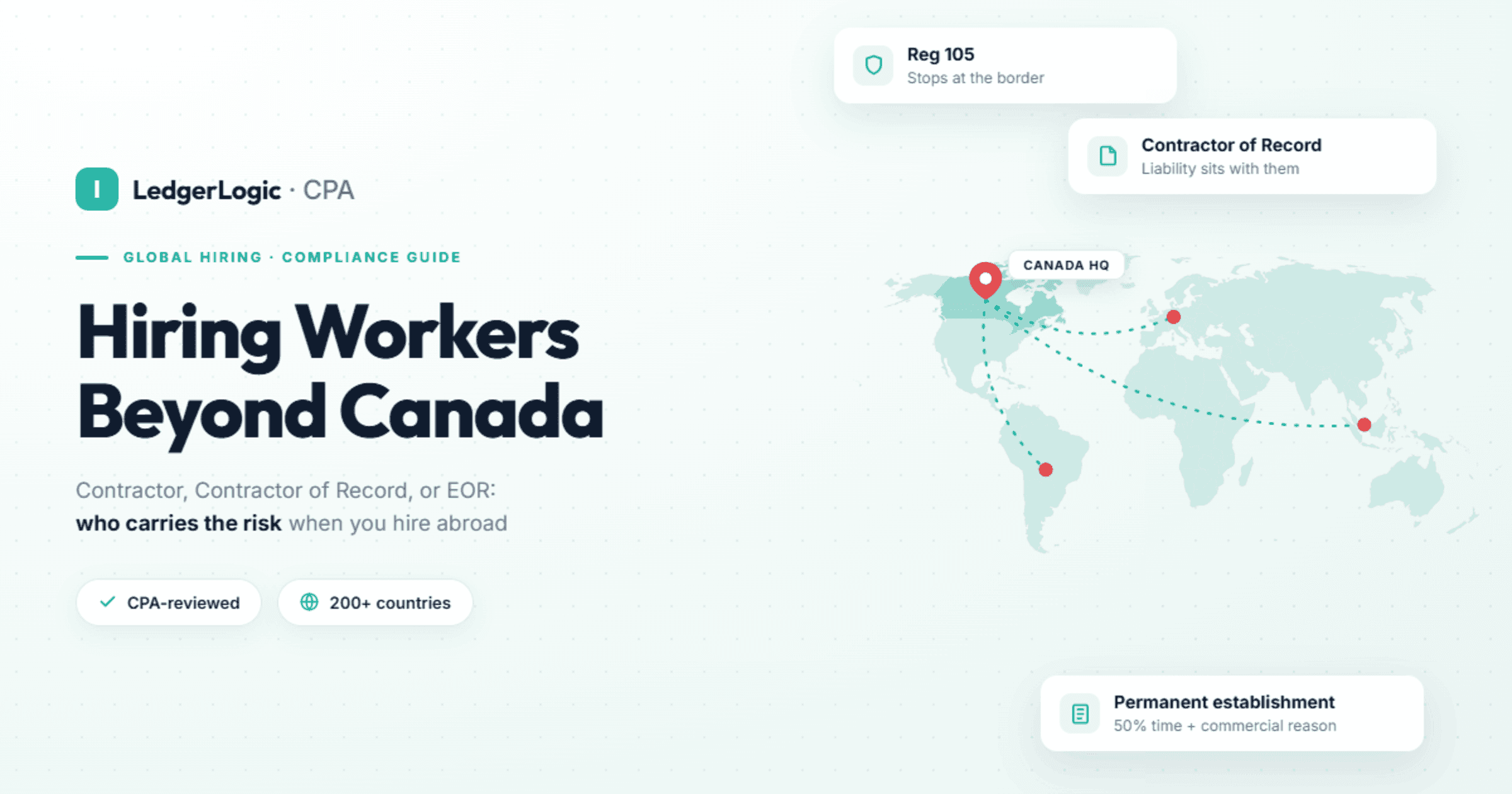
- Misclassification. Calling someone a contractor when the local test says employee. The liability is retroactive: back payroll taxes, statutory benefits, vacation and severance entitlements, interest and penalties, in the worker's jurisdiction, under their rules, not yours. No AI screening tool has any view on this.
- Payroll and withholding. Registering as an employer, withholding correctly, remitting on the local calendar and filing the local year-end. This is per country, and it does not scale by hiring faster.
- Permanent establishment. A senior person with contracting authority in a country can create a taxable presence for the whole company. That converts a hiring decision into a corporate tax problem, which is a much larger number than the salary.
Speed at the top of the funnel makes all three of these worse, not better, because volume rises while the per-hire compliance work stays constant. A team that goes from six hires a year to sixty using AI sourcing has multiplied its Layer 4 exposure tenfold without hiring anyone to manage it. I have written the mechanics of the classification decision in more depth in our guide to hiring contractors and employees abroad.
The infrastructure layer, and what it actually covers
Layer 4 is where a platform earns its fee, and it is the layer Deel is built for. The honest description is that it is compliance and payroll infrastructure, not a hiring tool. What it takes off your desk:
- Employer of Record. Deel's local entity becomes the legal employer in a country where you have none, so the employment relationship, statutory benefits and local filings sit with an entity that is already registered there.
- Contractor classification. The worker is assessed against the local test before the contract is signed, rather than after a tax authority asks. Contractor of Record shifts the misclassification liability onto a third party that has underwritten it deliberately.
- Local contracts and payroll. Locally compliant agreements, multi-currency payment, withholding and remittance on each country's calendar.
- One reporting surface. For the accountant, this is the underrated part. Global payroll consolidated into something that reconciles cleanly, rather than nineteen local providers emailing PDFs in nineteen formats.
The cost logic is straightforward: an EOR fee per worker per month against the cost of incorporating, registering and maintaining a payroll in each country, plus the retroactive exposure you avoid. Below roughly five people in a country the platform almost always wins on cost, and above that it becomes a real calculation. Our Deel review for Canadian businesses works through the pricing, and Deel versus Remote compares the two main options if you are choosing between them.
What the infrastructure layer does not cover
This is where most vendor-sponsored explainers stop being useful, so it is worth being direct. An EOR does not make your AI screening compliant. The two problems live at opposite ends of the stack.
- Bias audits remain yours. If your applicant tracking system scores candidates for a New York City role, Local Law 144 requires an independent annual audit of that tool. Your EOR has no visibility into it and no responsibility for it.
- Posting disclosure remains yours. Ontario's rule attaches to the job posting, which is published long before any platform is involved.
- The screening decision remains yours. Human rights liability for a discriminatory shortlist sits with the employer that used the tool, and pointing at a vendor is not a defence.
The practical read: you need a defensible answer at Layer 2 and a compliant structure at Layer 4, and no single vendor sells both. Anyone telling you otherwise is selling.
A short review you can run this quarter
- List every tool that touches an applicant and mark which ones score, rank or filter. That set is your regulated surface, and it is usually larger than people expect.
- Check your Ontario postings. Twenty-five or more employees and any automated screening means the posting needs an AI disclosure now.
- Map workers to jurisdictions, not to head office. Each one carries its own rulebook for both screening and employment.
- Re-run the classification test on every contractor engaged more than twelve months, especially where they work set hours or use your equipment.
- Book the EU date for December 2027, not August 2026, and use the extra time rather than assuming the obligation disappeared.
- Confirm who owns the bias audit for any tool used on New York City roles. If the answer is nobody, that is a finding.
The bottom line
AI has genuinely changed hiring in 2026, but it has changed the cheap, reversible part. The regulatory picture is messier than the headlines suggest: the two flagship regimes slipped to 2027, while disclosure rules in Ontario and Illinois landed quietly in January and are binding today. Meanwhile the expensive failures remain exactly where they were before any of this, in classification, payroll and permanent establishment, and they get worse as the funnel above them gets faster.
Treat AI as the accelerant at the top and infrastructure as the containment at the bottom. If you are hiring across borders and running that on spreadsheets and local providers, Deel is the layer worth pricing out first. If you are hiring in Canada, our guide to hiring employees in Canada and our comparison of Canadian payroll software cover the domestic side, and GST/HST on remote services covers the sales-tax question that follows cross-border work.
This article reflects publicly available information as at 18 August 2026. Employment and AI regulation is moving quickly and varies by jurisdiction. It is general information, not legal advice for your situation.
Frequently Asked Questions
Did the EU AI Act high-risk hiring rules start in August 2026?
Does the EU AI Act apply to a Canadian company with no European entity?
Does Ontario's AI job posting rule apply to my company?
Is there a Canadian federal law regulating AI in hiring?
Does using an Employer of Record make my AI screening compliant?
What is the difference between a bias audit and an AI disclosure?
Does hiring faster with AI increase misclassification risk?
What does Deel actually do in the AI hiring stack?

Sebastien ProstCPA, Ex-CRA
Licensed CPA with 10+ years of experience, including work with the Canada Revenue Agency. Founder of LedgerLogic, a cloud accounting firm serving Canadian SMEs. Xero Certified Advisor.