Best Business Bank Account for Sole Proprietors in Canada (2026)
Disclosure: this post contains affiliate links. If you sign up through one, we may earn a commission at no extra cost to you. We only recommend tools a CPA has reviewed from the vendor's own pages.
What is the best business bank account for a sole proprietor in Canada?
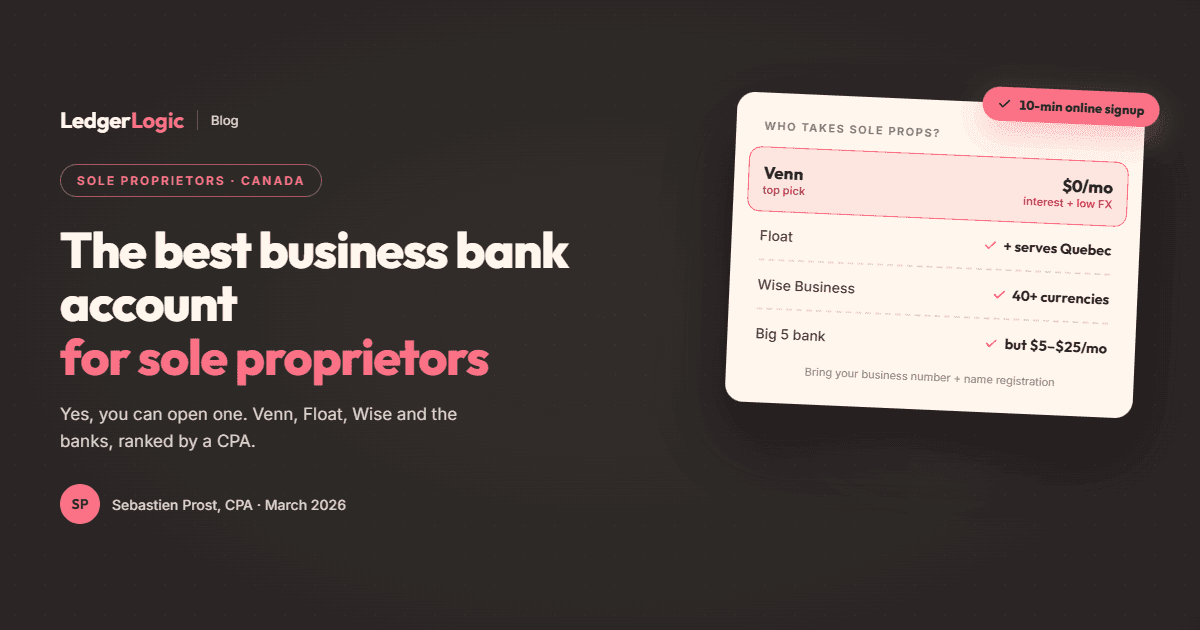
Yes, a sole proprietor can open a business bank account in Canada, and the best options in 2026 are fintechs, not branches. Venn is the top pick for most: $0 monthly, interest on CAD and USD balances, 0.45% FX on the free plan, and cards, open to registered sole proprietorships with a business number and name registration. Float also accepts registered sole props, serves Quebec (which Venn does not), and leads for card spending. Keep a Big 5 account only if you deposit cash or cheques. You will need your CRA business number and provincial registration document either way.
At a Glance
Yes, a sole proprietor can open a business bank account in Canada, and if you invoice under a business name or collect GST/HST, you should. The good news in 2026: you are no longer stuck choosing between a $20-a-month branch account and running everything through personal chequing. Two Canadian fintechs now take registered sole proprietorships with a 10-minute online application, and a CPA can tell you exactly which fits which situation.
Last updated: September 2026. Eligibility verified against each provider’s published requirements.
Sole Prop Banking Without the Monthly Fee
Venn opens accounts for registered sole proprietorships in about 10 minutes: $0 monthly, interest on CAD and USD balances, 0.45% FX on the free plan, and cards with 1% cashback, capped by plan. Bring your business number and name registration. Not in Quebec? Float accepts sole props there.
The Best Options for Sole Proprietors, Compared
| Account | Monthly fee | Sole props? | Best for |
|---|---|---|---|
| Venn | $0 | Yes, registered | Everyday banking: interest on balances, low FX, cards |
| Float | $0 (Essentials) | Yes, registered, and serves Quebec | Cards and spend management, interest on CAD and USD |
| Wise Business | $0 | Yes | Multi-currency holding and cheap transfers |
| Big 5 bank | Often $5-$25+ | Yes | Cash and cheque deposits, in-person service |
Venn: The Best Everyday Account for Most Sole Proprietors
Venn opens accounts for registered sole proprietorships: you need your business number and your business name registration document (the Master Business Licence in Ontario), and the application takes about 10 minutes online. What you get for $0 a month: CAD and USD accounts, 2% interest on CAD and USD balances, FX at 0.45% instead of the banks’ ~2.5%, corporate cards with 1% cashback on up to $5,000 of card spend a month on the free plan, and direct Xero/QuickBooks sync. Balances sit at Bank of Montreal, a CDIC member. The two limits that matter: no cash or cheque deposits, and Venn does not serve Quebec. Open a Venn account. The signup bonus on our Venn deal page is for registered corporations only, so a sole proprietor gets the account without it.
Float: Best for Cards and Spend, and the Quebec Answer
Float also accepts sole proprietorships registered federally or provincially that pass its business verification, and unlike Venn it serves Quebec, which makes it the default pick there by elimination. Float’s centre of gravity is different: corporate cards with strong controls, receipt capture, bill pay, and interest on idle balances (2.5% on CAD and 2.75% on USD, variable). Float cannot be your only account, though: its help centre says the account takes no pre-authorized debits, handles no cheques and cannot send Interac e-Transfers. Solo operators who spend mostly on cards (ads, software, materials) pair it with Venn (outside Quebec) or a bank: Venn or the bank for banking rails, Float for card spend. Get started with Float, or see the current Float offer.
Wise and the Big 5: The Supporting Cast
Wise Business takes sole proprietors and shines when your money crosses borders: 22 currencies with local account details, conversions from 0.19% after a one-time 55 CAD setup, and 2.22% interest on CAD balances (verified September 2026). It is a conversion-and-holding layer more than an operating account. A Big 5 account still earns its keep in exactly two cases: you handle cash or cheques, or you want lending and in-person service; expect a monthly fee and wide FX spreads for the privilege. Our full business account ranking covers the branch banks in detail.
Does a Sole Proprietor Legally Need a Separate Account?
Strictly, no law forces a sole proprietor to bank separately; you and the business are one legal entity. Practically, three things force your hand: banks require registration documents to open an account under your operating name (clients cannot deposit cheques written to your business name into personal chequing), GST/HST becomes far easier to track and defend once registered (mandatory past $30,000 of revenue), and the CRA expects business income to be traceable; mixing personal and business flows is the single most common reason small-business bookkeeping costs more than it should. Open the separate account the week you start invoicing, not at tax time.
What You Need to Open One
For the fintechs: your CRA business number, your business name registration (provincial registration document; the MBL in Ontario), and government ID. Registration itself costs about $60-$80 in most provinces, or about $49 through Ownr if you want it handled. If your income is climbing, read our guide to incorporating cheaply and the tax case for incorporating first; sole props who will incorporate within a year may as well open the account under the corporation once, not twice. When you incorporate, Venn incorporation files the incorporation and opens the business account in one flow: $299 federal or $449 Ontario, with $250 or $350 credited back once you load $500 within 30 days. For now it is open to Ontario businesses only.
Once the account is open, invoice from software, not from Word. For a freelancer or consultant billing time, FreshBooks is the tool we point sole proprietors to first: Lite is $26 a month CAD for 5 billable clients with unlimited invoices, expenses, time tracking and mileage, GST/HST goes on every invoice once you register, and the bank feed from Venn, Float or your bank imports automatically. Clients pay by card or pre-authorised debit from the invoice, which is the single biggest fix for slow payers. Our FreshBooks review has the plan-by-plan detail, and the Xero vs FreshBooks comparison covers the point at which a growing sole prop should move up.
Frequently Asked Questions
- Can a sole proprietor open a business bank account in Canada?
- Yes. Venn, Float, Wise, and every major bank open accounts for registered sole proprietorships. You need your business number and your provincial business name registration; the fintech applications are online and take about 10 minutes.
- What is the best business bank account for a sole proprietor?
- For most: Venn, with no monthly fee, interest on balances, low FX, and cards in one account. Float is the pick in Quebec (Venn does not serve the province) and for card-heavy spending. A Big 5 account only wins if you deposit cash or cheques.
- Can I just use my personal chequing account?
- If you operate under your own legal name and stay under the GST/HST threshold, you can, but cheques written to a business name will not deposit, GST tracking gets messy, and untangling mixed transactions at tax time usually costs more than the account ever would. Separate from day one.
- Do I need a GST number as a sole proprietor?
- Registration becomes mandatory once your worldwide taxable revenue passes $30,000 over four consecutive quarters. Below that it is optional, and registering early can make sense to recover GST/HST on your startup costs. In Quebec, QST registration runs alongside GST.
- What documents do Venn and Float ask for?
- A registered sole proprietorship, your CRA business number, your business name registration document (the Master Business Licence in Ontario), and government ID for the owner; Venn also asks for your social insurance number. No branch visit for either.
- I am in Quebec. What are my options?
- Float serves Quebec and accepts registered sole proprietorships, which makes it the leading fintech option there. Venn does not currently serve Quebec businesses. The Big 5 and Desjardins remain the answer for cash, cheques and pre-authorized debits, which Float does not handle, and Quebec sole props register with the REQ for their NEQ before opening.
- Should I incorporate instead of staying a sole proprietor?
- Incorporate when you can retain roughly $30,000 to $40,000 a year in the business, need liability protection, or foresee selling. Below that, a sole proprietorship with a clean separate account is usually the right cost-benefit answer. Our tax-benefits guide covers the full decision.

Sebastien ProstCPA, Ex-CRA
Licensed CPA with 10+ years of experience, including work with the Canada Revenue Agency. Founder of LedgerLogic, a cloud accounting firm serving Canadian SMEs. Xero Certified Advisor.
