Disclosure: this post contains affiliate links. If you sign up through one, we may earn a commission at no extra cost to you. We only recommend tools a CPA has reviewed from the vendor's own pages.
How should a physiotherapy clinic in Canada do its bookkeeping?
Physiotherapy is GST/HST exempt in Canada, so treatment revenue carries no tax, but you generally cannot claim input tax credits, and product sales like braces and orthotics are taxable. The real challenge is billing: patients, extended health, WSIB, and auto insurers each pay on their own schedule, so the books run on receivables, not date matching. The clean stack is Jane App for the practice and Xero for the accounting.
Partner offer
Jane App is free for your first month with code LEDGERLOGIC1MO
Jane's pricing page lists no free trial or coupon codes. Enter the code in the Grace code field on the Jane Sign Up page (Step 1) and one complimentary month is applied to a new Canadian clinic subscription.
The quick version
Physiotherapy clinics have some of the most complicated books in allied health, and it has little to do with the accounting software. It is the billing. A single physio practice can collect from patients directly, from extended health insurers, from WSIB or WorkSafeBC, and from auto insurers after a motor vehicle accident, each paying on its own schedule and its own terms. Layer the GST/HST exemption and associate splits on top, and a clinic that looks simple on the surface is anything but. This is a CPA guide to bookkeeping for Canadian physiotherapy clinics: the tax treatment, the third-party billing that trips everyone up, the incorporation question, and the Jane App plus Xero stack we recommend for these practices. It sits alongside our broader guide to accounting for Canadian clinics.
Choosing clinic software? See the physiotherapy picks in our clinic software comparison.
Do physiotherapists charge GST/HST in Canada?
No. Physiotherapy is on the federal list of health care services that are exempt from GST/HST, alongside chiropractic, so its treatment revenue carries no tax. When you bill a patient, an insurer, WSIB, or an auto insurer for a physiotherapy assessment or treatment, you do not add GST/HST, and that treatment income does not create a requirement to register for a GST/HST number. It is the same position chiropractors are in, and the opposite of massage therapy, where the practitioner is generally not on the exempt list and treatment revenue is usually taxable. We cover that contrast in bookkeeping for chiropractors and bookkeeping for massage therapists.
The catch: no input tax credits, and taxable product sales
Exempt is not the same as free of tax consequences. Because you do not charge GST/HST on exempt physiotherapy, you generally cannot claim input tax credits on the GST/HST you pay for rent, equipment, software, and supplies. That tax becomes part of your cost, so record those expenses at their full GST/HST-inclusive amount.
The wrinkle specific to physio clinics is products and non-exempt services. Selling braces, orthotics, TENS units, kinesiology tape, supplements, or exercise equipment is a taxable retail activity, not exempt treatment. So are some services a clinic offers alongside therapy, such as gym or studio memberships, personal training, or wellness programs that are not physiotherapy. Once that taxable side passes the $30,000 small-supplier threshold, you have a GST/HST registration obligation on that slice, even though your treatment revenue stays exempt. A clinic doing $400,000 of exempt treatment and $45,000 of brace and orthotic sales is registered whether the owner realizes it or not. Track product and non-exempt revenue as its own stream from day one.
WSIB, auto insurance, and extended health billing
This is where physiotherapy bookkeeping earns its reputation. A busy clinic reconciles four different payers, and each behaves differently:
- Patients directly: paid at the time of service, the cleanest stream.
- Extended health insurers (through TELUS eClaims, Pacific Blue Cross, and others): direct-billed at the visit, but the clinic is paid days or weeks later, so the receivable has to be tracked and matched to the deposit when it lands.
- WSIB or WorkSafeBC: workplace-injury rehab billed to the provincial workers' compensation board on its fee schedule, approved by claim, and paid on the board's timeline. Denials and adjustments are common and have to be reconciled against what you billed.
- Auto insurers: motor-vehicle-accident rehab, governed by provincial rules (statutory accident benefits in Ontario, ICBC in British Columbia, and so on), usually pre-approved to a treatment plan and paid slowly. This is frequently the slowest and most paperwork-heavy receivable a clinic carries.
The bookkeeping consequence is that your Jane revenue report and your bank deposits will almost never match on a given day, because billed is not the same as collected. The job is to record revenue when it is earned, carry the receivables from WSIB, auto, and insurers, and reconcile each payer's remittance against the claims it covers. Done loosely, a clinic overstates or understates revenue by tens of thousands a year and never knows which. This is the single biggest reason physio owners outgrow doing their own books.
Sole proprietorship vs professional corporation
A new or part-time physiotherapist usually operates as a sole proprietor. Once the clinic consistently earns more than the owner needs to draw out to live on, a corporation starts to pay off, because a professional corporation is taxed at the small business rate (roughly 9 to 12 percent combined on the first $500,000 of active business profit, depending on province) and lets you defer personal tax on the earnings you leave in the company. Our guide to the tax benefits and disadvantages of incorporating in Canada walks through the full decision, and the small business tax rate by province numbers are here.
One point a generic online incorporation tool will not tell you: a regulated physiotherapist who incorporates their practice needs a professional corporation, and that is not a do-it-yourself filing. Most provinces require a certificate of authorization from the College of Physiotherapists before the corporation can provide physiotherapy, restrict the voting shares to members of the profession, and apply naming rules. That is a lawyer-led setup done in coordination with your college, not something to run through a self-serve incorporation site. Those sites suit a sole-proprietor registration or an unregulated standard corporation, but not a physiotherapy professional corporation. We advise on whether incorporating makes sense and coordinate the professional corporation with the right people; the broader picture is on our clinic accounting service page.
Which practice software suits a physiotherapy clinic in Canada?
Jane App suits a physiotherapy clinic on one site or a few; Juvonno suits a multi-location rehab group that bills HCAI, OHIP or Manitoba Health every day. Jane's Insurance Billing add-on, on the Practice and Thrive plans at $20 a month plus $5 per additional full-time practitioner, sends physiotherapy claims to TELUS eClaims from inside Jane, and in BC it also covers Teleplan and Pacific Blue Cross PROVIDERnet. Jane's Practice plan is $79 CAD a month including one full-time practitioner, then $35 for each additional full-time and $17.50 for each part-time practitioner, with online booking, charting and 1:1 telehealth on every plan. Juvonno prices per location plus a licence for each concurrent user, sells HCAI and provincial health billing as an add-on, and includes TELUS eClaims on its Grow and Scale plans. New Jane clinics get the first month free with code LEDGERLOGIC1MO in the Grace code field (see our Jane App promo code page), and the physiotherapy picks in our clinic software comparison set out both.
The software stack for a physio clinic
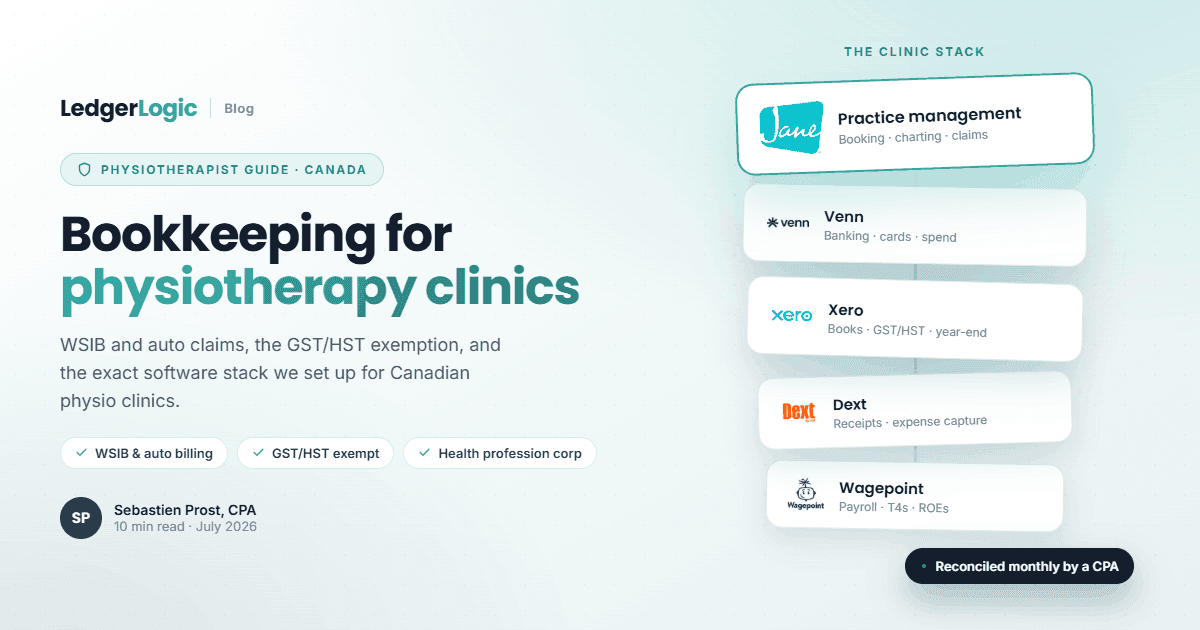
The setup we recommend for physiotherapy clinics is a five-tool stack, and the point is that each piece does one job well and hands clean data to the next.
- Jane App for the practice: online booking, scheduling across multiple practitioners and treatment rooms, charting, and direct billing to extended health insurers through TELUS eClaims. Our Jane App review covers what each plan includes, and the clinic management comparison stacks it against Cliniko and Practice Better. New clinics can start with a free month using code LEDGERLOGIC1MO on our Jane App promo code page.
- Venn for banking, cards, and spend: an incorporated clinic can open a Venn business account online in minutes, issue corporate cards to associates and staff with spend controls, and keep fees low, and it syncs into Xero so your bookkeeper works from live data. Our Venn review has the details, and you can open an account through our Venn signup link.
- Xero for the accounting: a chart of accounts built for a clinic, bank reconciliation, receivables tracking for the WSIB and auto claims above, and year-end reporting. You can start Xero through our partner link (80% off for 6 months) when you are ready.
- Dext for receipts: snap a photo of a supplier invoice or an equipment purchase and it extracts the data and pushes it into Xero, which keeps your non-recoverable GST/HST recorded correctly. Dext is 90 percent off for three months through our link.
- Wagepoint for payroll: most physio clinics have employed physiotherapists, physiotherapy assistants, or admin staff, which means real payroll with CPP, EI, T4s, and ROEs. Wagepoint handles Canadian payroll cleanly and is compared in our payroll software guide.
Jane does not push data into Xero automatically, so once a month you export a revenue report from Jane and import it into Xero, then reconcile against deposits from patients, insurers, WSIB, and auto. The step-by-step is in how to import Jane App sales into Xero, and the full monthly routine is in our guide to bookkeeping for a Jane App clinic.
Run Your Clinic on Jane, Free for a Month
Jane App handles booking, charting, insurance billing and payments for Canadian health clinics. Jane's pricing page lists no free trial; new clinics that enter the code below at signup get one month free.
Mention this code at signup
What to track each month
- Exempt treatment revenue from patients, insurers, WSIB, and auto, recorded when it is earned.
- Taxable product and non-exempt revenue (braces, orthotics, supplements, memberships, training) tracked separately because it counts toward the $30,000 threshold.
- Receivables by payer: what WSIB, each auto insurer, and each extended health plan owe you, matched to remittances as they arrive.
- Associate and contractor splits: what each associate physiotherapist billed versus what the clinic pays them, kept clean for the contractor-versus-employee question below.
- Expenses at full cost: rent, equipment, Jane, Xero, Dext, college dues, liability insurance, and continuing education, recorded GST/HST-inclusive because it is generally not recoverable.
Common bookkeeping mistakes physio clinics make
- Matching Jane to the bank by date. Billed is not collected. WSIB and auto pay weeks later, so revenue and deposits will not line up day to day; you reconcile through receivables, not by forcing the two to match.
- Ignoring taxable product sales. Braces, orthotics, and supplements quietly cross $30,000 and create a GST/HST registration obligation the owner never saw coming.
- Claiming input tax credits on exempt costs. Once treatment is exempt, the GST/HST on rent, equipment, and software generally is not recoverable. Claiming it invites a reassessment.
- Treating associates as contractors without testing it. An associate physiotherapist on a percentage split may be an employee in the CRA's eyes, and getting it wrong creates payroll liability.
- Running the professional corporation like a standard company. The college certificate of authorization, share restrictions, and annual renewals are ongoing compliance obligations, not one-time paperwork.
When to hire a bookkeeper
A solo physiotherapist billing mostly patients and insurers can run the books with Jane, Xero, and an hour or two a month. The complexity, and the case for handing it off, jumps when you carry meaningful WSIB and auto receivables, when you add associates and have to settle contractor-versus-employee questions and split calculations (where a payroll tool like Wagepoint earns its keep), when product sales push you into partial GST/HST registration, or when you incorporate and take on corporate books, payroll, and a T2 return.
Frequently asked questions
Do physiotherapists charge GST/HST in Canada?
No. Physiotherapy is an exempt health care service, so treatment revenue carries no GST/HST and does not require registration on that income. The exception is taxable side revenue such as braces, orthotics, supplements, and non-therapy services, which can require registration once it passes $30,000 over four consecutive quarters.
How do you do bookkeeping for WSIB and auto insurance billing?
You record physiotherapy revenue when it is earned and carry a receivable for each payer, then reconcile WSIB, auto insurer, and extended health remittances against the claims they cover as they are paid. Because these payers settle on their own schedules, your Jane revenue report and bank deposits will not match day to day; the receivables bridge the gap.
Can a physiotherapist incorporate in Canada?
Yes, as a professional corporation, but it is a lawyer-led setup. Most provinces require a certificate of authorization from the College of Physiotherapists, restrict voting shares to members of the profession, and apply naming rules, so it is not a do-it-yourself online incorporation.
What software do physiotherapy clinics use for bookkeeping?
Most Canadian physio clinics run Jane App for booking, charting, and insurance billing, Xero for the accounting, Dext for receipts, and a payroll tool such as Wagepoint for employed practitioners. Jane exports a monthly revenue report that is reconciled into Xero against deposits from patients, insurers, WSIB, and auto.
Is physiotherapy GST/HST exempt but massage therapy taxable?
Yes, in most cases. Physiotherapists are on the federal list of exempt health practitioners; massage therapists generally are not, so RMT treatment revenue is usually taxable. A clinic that offers both has a mixed supply and has to handle each correctly.
Do I charge GST/HST on orthotics and braces?
Generally yes. Selling orthotics, braces, and similar products is a taxable retail activity separate from exempt treatment. Once your taxable product and service revenue passes $30,000 over four consecutive quarters, you must register and charge GST/HST on that stream.

Sebastien ProstCPA, Ex-CRA
Licensed CPA with 10+ years of experience, including work with the Canada Revenue Agency. Founder of LedgerLogic, a cloud accounting firm serving Canadian SMEs. Xero Certified Advisor.